
Why More and More Factories Are Choosing Them
Introduction: The Intelligent Transformation of the Grinding Process in Manufacturing
In the manufacturing value chain, grinding, polishing, and deburring, as crucial surface finishing processes, have long represented significant bottlenecks in quality, efficiency, and cost control.
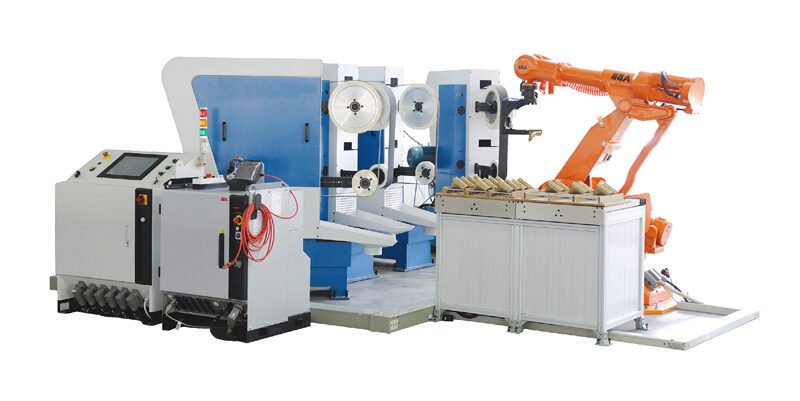
Traditionally relying on the skill and experience of seasoned technicians, these processes often result in quality fluctuations, limited production capacity, and compromised working conditions in challenging environments.
As global manufacturing competition shifts toward high precision, consistency, rapid response, and green production, the limitations of traditional grinding methods are becoming increasingly apparent.
Concurrently, the maturation of flexible automation technologies centered on industrial robots has provided a solid technical foundation for transforming this classical process.
Robotic belt grinding systems are rapidly evolving from a forward-looking technology into a strategic choice for driving intelligent factory upgrades and reshaping core process capabilities. Behind this trend lies a systematic transformation in quality philosophy, production models, and cost structures.
Comprehensive Advantages Panorama: Beyond Replacement, Toward Value Re-engineering
Robotic belt grinding is not merely about “replacing humans with machines” in a simplistic sense. Rather, it fundamentally re-engineers the value of the grinding process through technological integration and process digitization. Its advantages are manifested across the following interconnected dimensions.
I. Quality Dimension: Shifting from Experience-Driven to Data-Driven Process Determinism
Traditional grinding quality control is deeply rooted in the individual experience and immediate state of the worker. This form of “tacit knowledge” is difficult to standardize, quantify, and pass on, making product consistency a significant challenge. Robotic systems fundamentally transform this paradigm:
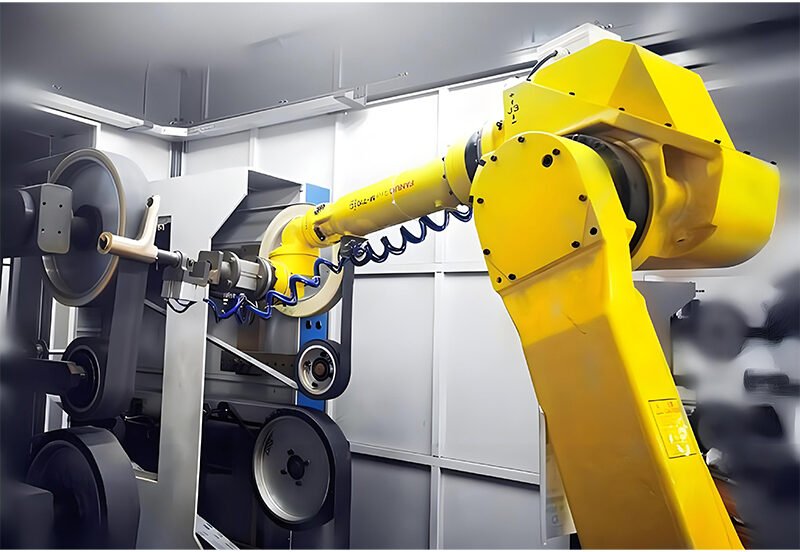
Fully Digital Definition and Closed-Loop Control of Process Parameters:
Robotic belt grinding converts all critical process variables—such as pressure, speed, trajectory, and contact angle—into data that can be precisely set, adjusted in real-time, and fully recorded. Utilizing high-precision force/torque sensors and advanced control algorithms, the system achieves constant contact force or compliance control.
Even when dealing with complex curved surfaces or variations in workpiece tolerances, it ensures uniform material removal rates, eliminating over-grinding, under-grinding, and surface damage inherent to manual operations.
Absolute Repeatability and Traceability:
The extremely high repeatable positioning accuracy of industrial robots guarantees that every workpiece follows an identical motion path. The complete set of parameters for each operation is stored, creating a digital “process fingerprint.”
This not only makes zero-variation mass production possible but also provides an unprecedented data foundation for quality tracing, process replication, and continuous optimization. It represents a shift in quality control from sampling final results to comprehensive process monitoring.
Ⅱ. Efficiency and Flexibility Dimension: Breaking Through Production Bottlenecks to Respond to Dynamic Markets
Manufacturing is facing challenges such as shortened product life cycles and rising customization demands, making production flexibility increasingly crucial.
Breaking Through Physical Constraints of Labor and Time:
Robotic systems are capable of stable, continuous 24/7 operation, unaffected by fatigue, shift changes, or employee turnover. This elevates Overall Equipment Effectiveness (OEE) to a new level.
Their work cycles are stable and precisely calculable, facilitating seamless integration with upstream and downstream processes, whether within automated production lines or flexible manufacturing cells (FMCs).
Enabling Rapid Changeovers and High-Mix Production:
Through offline programming and digital process libraries, switching to produce different products requires only calling up the corresponding program and end-of-arm tooling. This dramatically reduces the time traditionally needed for fixture adjustments, trial grinding, and worker retraining.
This “one-touch changeover” capability allows companies to economically handle small-batch, high-variety production orders, transforming production flexibility into a competitive market advantage.
The capability of robotic belt grinding systems to handle complex geometries:
It is a key manifestation of their superiority over traditional manual grinding and their ability to achieve process breakthroughs. This capability not only addresses existing production challenges but also fundamentally expands the freedom of engineering design.
At its core lies spatial motion and posture control that is both “human-like” and “superhuman.” Six-axis or higher-degree-of-freedom industrial robots mimic and surpass the flexibility of the human arm. Their joint-space kinematics grant the end-effector near-complete reachability in three-dimensional space.
Coupled with specialized offline programming and path planning software, engineers can pre-plan optimal grinding trajectories and robot posture sequences in a virtual environment based on precise CAD models of the workpiece.
This enables the system to approach the workpiece surface from the most appropriate angles and orientations, ensuring that the grinding tool (such as the abrasive belt contact wheel) maintains an ideal perpendicular contact with curved surfaces. Consequently, precise control over contact pressure and material removal rate is achieved.
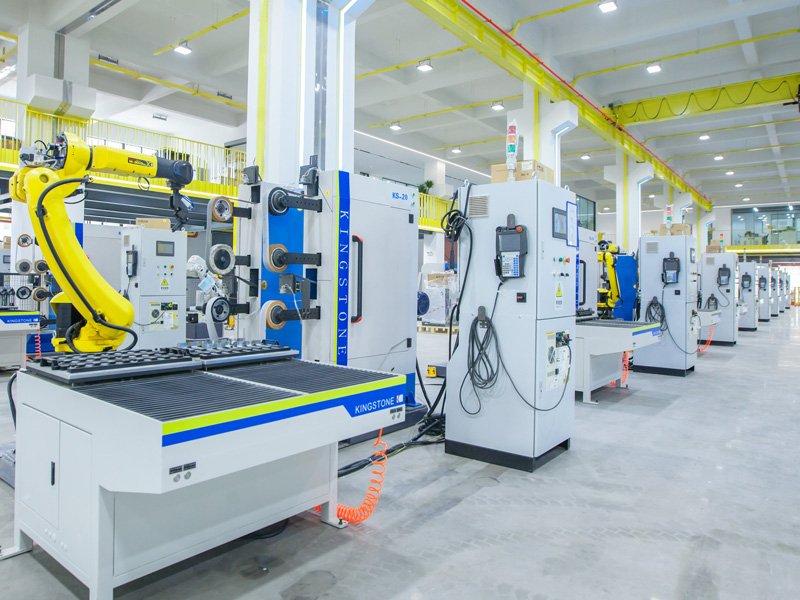
Specifically, this capability addresses the following types of process challenges that are difficult to achieve with traditional methods:
1. Finishing of Internal Cavities and Confined Spaces: For internal structures of housings, deep cavities, or pipe interiors, manual operations are often limited by arm reach, visual obstructions, and tool size, making effective or consistent grinding difficult or impossible.
Robots can be equipped with slender extensions or specialized internal cavity grinding tools to strictly follow predefined paths, delivering high-quality surface treatment in fully enclosed or visually restricted spaces.
2. Processing of Deep Holes, Micro-Chamfers, and Fine Features: Deburring tiny hole edges on high-precision components or polishing clear chamfers at complex junctions is prone to over-cutting or omission in manual operations due to unstable tactile control.
Leveraging micron-level repeatability and stable low-speed motion performance, robots can precisely execute finishing tasks on these fine features, ensuring uniformity and integrity.
3. Uniform Grinding of Complex Free-Form Surfaces: Achieving uniform material removal and consistent surface finish on workpieces with complex curved geometries, such as impellers, propellers, or custom molds, poses a challenge even for highly skilled technicians.
Through dense path point planning and continuous posture adjustments, robots can maintain the grinding force vector perpendicular to the surface normal across the entire contour.
This enables uniform material removal across complex free-form surfaces, preventing localized pits or uneven transitions—a level of consistency difficult to replicate systematically with manual expertise.
Ⅲ. Total Cost Dimension: Re-engineering Lifecycle Economic Benefits
When evaluating the return on investment in robotic belt grinding systems, it is essential to move beyond the traditional mindset focused solely on upfront procurement costs and adopt a Total Cost of Ownership (TCO) analysis framework that covers the equipment’s entire lifecycle.
This perspective incorporates hidden costs, long-term benefits, and strategic gains, often revealing investment value far exceeding expectations.
Optimization and Re-engineering of Direct Labor Costs:
The most immediate benefit of system implementation is the reduced reliance on scarce and expensive, highly skilled grinding technicians. However, its deeper value lies in the structural upgrading and value re-engineering of human resources.
Enterprises can systematically transform existing direct operators into process engineers, robot programmers, equipment maintenance specialists, and online quality inspectors. This not only alleviates the challenge of “difficult recruitment” but also liberates human resources from repetitive manual labor, redirecting them toward roles with higher knowledge intensity and greater creativity.
This process achieves a fundamental shift from “labor cost” to “human capital,” building internal capabilities for continuous optimization and innovation within the organization. Furthermore, it can significantly reduce production fluctuations and hidden management costs associated with employee turnover, training cycles, and skill variations.
Systematic Reduction in Quality Costs and Consumables Costs:
The extreme process consistency delivered by robotic belt grinding directly targets the most hidden bastion of manufacturing costs—quality costs. It dramatically minimizes losses arising from manual variability, such as scrap, rework, and the associated material waste, extra labor hours, delivery delays, and customer claims.
More importantly, it safeguards brand reputation and customer trust—an intangible yet critical value difficult to quantify. Regarding consumables, precise constant-force control and optimized motion paths prevent the abnormal wear of sanding belts and grinding wheels caused by uneven pressure, redundant paths, or improper angles in manual operations.
Practical applications demonstrate that, under the same processing requirements, robotic systems can extend the lifespan of key consumables by 30% to 50% and reduce downtime caused by frequent replacements, achieving cost reduction and efficiency improvement across the entire chain from procurement to usage.
Improvement in Operational and Energy Efficiency:
As an integrated system, robotic belt grinding cells exhibit efficiency advantages across multiple levels. At the direct operational level, their stable high cycle times and near 100% equipment utilization rate significantly increase output per unit of time and space.
At the auxiliary system level, integrated high-efficiency centralized dust collection and mist filtration units not only create a cleaner working environment and ensure compliance with environmental regulations but, more critically, achieve superior collection effectiveness with lower energy consumption compared to decentralized, inefficient traditional dust extraction methods.
This reduces long-term environmental management costs and safety risks. In terms of energy management, robots have stable and predictable power consumption patterns, facilitating precise load planning and energy efficiency optimization within factories.
Furthermore, the shortened production cycles they enable indirectly reduce the operational energy consumption of overall facility systems such as lighting and ventilation. Additionally, the high reliability of the system minimizes unplanned downtime, enhancing the predictability and stability of overall production operations.
Ⅳ. Sustainability and Work Environment Dimension: Implementing ESG Development Principles
The competitiveness of modern manufacturing enterprises is closely linked to their social responsibility. Robotic belt grinding makes significant contributions in this regard:
Creating a Human-Centric Work Environment: It liberates workers from “3D” (dirty, demanding, and hazardous) tasks characterized by high dust, noise, and risks of repetitive strain injuries. This demonstrates a strong commitment to employee health and safety, contributing to increased job satisfaction and a positive corporate image.
Enabling Green Manufacturing and Targeted Environmental Protection: The system can be integrated with highly efficient dust extraction, mist collection, and waste chip recovery units. This controls pollutant emissions at the source, making it easier to comply with increasingly stringent environmental regulations and facilitating resource recycling.
Empowering Corporate Sustainable Development Strategy: By improving energy efficiency, reducing waste, and enhancing working conditions, robotic belt grinding directly contributes to a company’s Environmental, Social, and Governance (ESG) goals.
This strengthens its appeal within responsible supply chains, particularly aligning with the expectations of international high-end clients and capital markets for sustainable manufacturing.
Ⅴ. Digitalization and Intelligence Dimension: The Data Gateway to the Future Factory
Robotic belt grinding cells inherently serve as data-generating nodes and process execution terminals, providing critical support for manufacturing digitalization.
Comprehensive Collection and In-depth Utilization of Process Data: Real-time acquisition of equipment status, process parameters, and quality inspection data can be used to build process digital twins, enabling predictive maintenance, self-optimization of process parameters, and real-time prediction of product quality.
Vertical Integration and Horizontal Collaboration: As flexible automation units, robotic belt grinding systems can be seamlessly integrated into Manufacturing Execution Systems (MES) and even Enterprise Resource Planning (ERP) systems.
This enables full traceability and transparent management of orders, processes, production, and quality, transforming them into “intelligent cells” within the organic structure of a smart factory.
The Broad Prospects of AI Integration: Combining machine vision for workpiece identification, defect detection, and adaptive path planning; utilizing machine learning algorithms to analyze vast amounts of process data, searching for optimal parameter combinations, and even achieving autonomous process decision-making. This represents the evolution of grinding processes from automation toward intelligence.
Implementation Path and Success Factors: A Systematic Engineering Mindset
Successfully deploying a robotic belt grinding system is a systematic engineering project involving technology, processes, and management, requiring careful planning.
In-depth Process Analysis and Requirement Definition in the Initial Phase: Clearly define the material properties, geometric characteristics, quality specifications (e.g., roughness, profile), production capacity targets, and cycle time requirements for the workpieces to be processed.
This serves as the foundation for selecting the appropriate robot model, end-of-arm tooling (EOAT), and force control solutions.
Selecting a Partner with Comprehensive Capabilities: The ideal partner should possess both robotics and automation integration expertise and a deep understanding of grinding processes specific to the industry (Process Know-how).
They should be capable of providing end-to-end services, from process testing, cell design, and simulation to installation, commissioning, training, and support.
Emphasis on End-Effector and Peripheral System Integration: The selection and design of end-of-arm tools—such as abrasive belt heads, contact wheels, and constant-force devices—as well as the quality of integrating peripheral systems like dust collection, workpiece positioning, and safety guarding, directly determine the final system’s performance and reliability.
Internal Capability Building and Phased Implementation: Developing internal team capabilities in robot operation, basic programming, and maintenance is crucial. Adopting a “point to line, line to surface” implementation strategy—starting with a pilot project on a mature, high-return process to gain experience before gradually expanding—effectively controls risk and ensures return on investment.
Future Outlook: Technology Convergence and Ecosystem Evolution
Looking ahead, robotic belt grinding technology will continue to evolve toward greater precision, intelligence, ease of use, and ecosystem development:
Deep Integration of Perception and Control Technologies: The combination of more sensitive force/tactile sensors and 3D visual guidance will enable robots to “sense” workpiece conditions in real-time and make intelligent adjustments, handling unknown workpiece variations and moving toward adaptive, intelligent grinding.
Widespread Adoption of Collaborative Robots (Cobots): Their ease of programming and safe collaboration features will significantly lower the barrier to entry for small- to medium-batch production and human-robot collaboration scenarios, expanding the application scope of robotic belt grinding.
Enhanced Role of Process Software and Digital Twins: Offline programming and simulation software will become more intelligent, capable of automatically generating optimized paths based on CAD models. Virtual commissioning through digital twins will greatly reduce engineering deployment time.
Advancement of Standardization and Modularization: As applications scale up, standardizing grinding tools and process modules, along with unified interfaces, will help reduce costs, accelerate technology adoption, and foster a richer industrial ecosystem.
Conclusion: Embrace Process Transformation to Build the Foundation of Intelligent Manufacturing
The widespread adoption of robotic belt grinding systems signifies a profound digital transformation within a core manufacturing process. It addresses not only the immediate challenge of labor shortages but also serves as a long-term strategy for building enduring competitiveness:
By achieving digitized, standardized, and optimized processes, companies secure the stability and excellence of product quality. By attaining ultra-high production flexibility, they gain the agility to respond to market demands.
By realizing systematic optimization of total costs, they enhance profitability and resilience.
By implementing green and human-centric manufacturing practices, they cultivate a responsible, modern brand image.
For manufacturing enterprises committed to high-quality development, investing in robotic belt grinding transcends a mere cost-based decision. It represents a strategic re-engineering of core process capabilities and an essential pathway toward intelligent, flexible, and sustainable future manufacturing.
In this data- and intelligence-driven industrial revolution, companies that pioneer the automation upgrade of their critical processes are quietly constructing robust barriers for the future.