
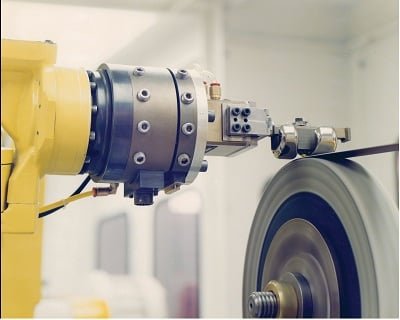
Mastering Constant Force Control for Flawless Robotic Polishing
When you look at a “finished” aerospace blade or a high-gloss smartphone casing, surface waviness might seem like a cosmetic issue. But for manufacturers, it’s a silent killer of performance, aerodynamics, and, ultimately, profit margins.
At Kingstone Robotec, we often see clients struggling with inconsistent surface finishes. They blame the polishing media or the robot programming, but the root cause is usually deeper: traditional position-controlled robots cannot adapt to the real world.
In this post, we break down why standard automation fails to eliminate waviness and how Constant Force Control (CFC) technology provides a fundamental solution.
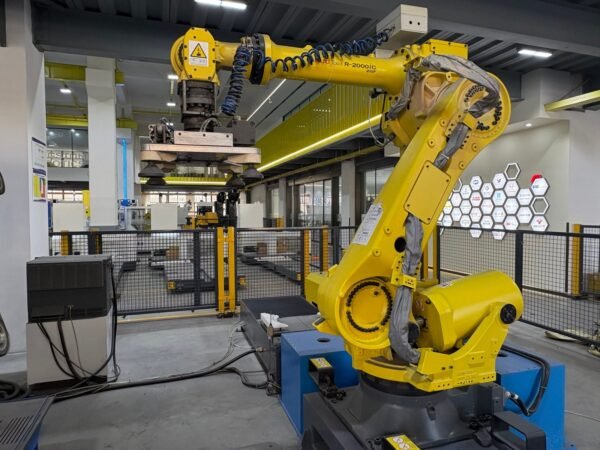
The “Rigid” Robot Problem
Imagine trying to use constant force control to sand a piece of wood with your eyes closed, moving your hand to a pre-measured height. If the wood surface has even a tiny bump or dip, your sander will either dig in too deep or miss the surface entirely.
This is exactly how most industrial robots operate. They are masters of position, but they are blind to force.
In a perfect world, this wouldn’t be a problem. But manufacturing is messy:
- Raw Material Variations: Billets are never perfectly uniform.
- Fixturing Errors: Parts shift slightly when clamped.
- Path Deviations: Complex curves are hard to program perfectly.
When a rigid robot hits a bump, the force spikes. When it hits a dip, the force drops. This fluctuation in pressure directly translates into uneven material removal, which manifests as visible “waves” on the surface.
How Constant Force Control Works: Giving Robots a “Sense of Touch”
To solve waviness, we need to shift the paradigm from Position Control to Force Control. At Kingstone Robotec, we equip our robotic polishing systems with a “tactile nervous system.”
Think of it as giving the robot a spring-loaded wrist and a brain that reacts in milliseconds.
The Core Mechanism:
- Perception (The Skin): A high-precision force sensor (usually mounted on the wrist or spindle) detects contact pressure thousands of times per second.
- Calculation (The Brain): The controller compares the actual force with the desired setpoint (e.g., 10N).
- Action (The Muscle): If the sensor detects a bump (force > 10N), the actuator instantly retracts the tool. If it detects a dip (force < 10N), it extends.
The result? The robot floats along the surface contour like a hovercraft, maintaining a perfectly constant pressure, regardless of the underlying imperfections.
Why This Matters for Your Bottom Line
Eliminating waviness isn’t just about aesthetics; it’s about process stability. Here is how CFC technology translates into real-world value for your factory:
| Challenge | Traditional Position Control | Kingstone Robotec CFC Solution |
|---|---|---|
| Surface Finish | Visible waves, inconsistent gloss (Ra value fluctuates). | Mirror-like finish. Eliminates “chatter marks” and water-ripple effects. |
| Scrap Rate | High risk of over-polishing (burn-through) or under-polishing. | Near-zero scrap. The tool cannot exert more force than set, protecting critical dimensions. |
| Tool Life | Abrasive tools wear unevenly due to pressure spikes. | Extended tool life. Consistent pressure prevents clogging and abnormal wear. |
| Programming | Requires “perfect” paths; hours spent on offline fitting. | Simplified programming. The robot adapts to the part; no need for perfect CAD alignment. |
Applications: Where Perfection is Non-Negotiable
While CFC technology benefits any polishing task, it is indispensable in high-end sectors:
- Aerospace & Turbomachinery: For compressor blades and blisks where aerodynamic efficiency depends on flawless surface profiles.
- 3C Electronics: For the mirror polishing of aluminum alloy frames where any micro-waviness ruins the optical reflection.
- Medical Implants: Where surface waviness can create stress concentration points, risking biocompatibility.
Conclusion
Surface waviness is a symptom of a rigid process meeting an imperfect world. By adopting Constant Force Control, manufacturers stop fighting the physics of material variation and start working with it.
At Kingstone Robotec, we don’t just sell robots; we engineer intelligent finishing processes. If you are tired of manual rework and inconsistent quality, it might be time to let your robot “feel” its way to a perfect finish.
Ready to eliminate surface waviness in your production line?
👉 Contact Kingstone Robotec for a Process Consultation