
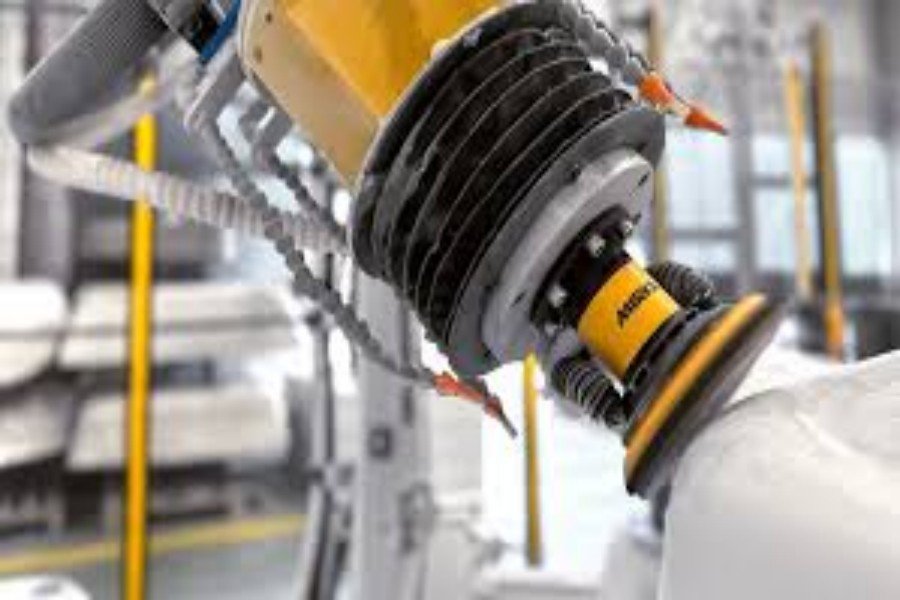
Automated grinding has evolved into a foundational element of advanced manufacturing, delivering the precision, efficiency, and repeatability that today’s industries demand. As production volumes grow and tolerances tighten, manufacturers across sectors—from automotive to aerospace—are increasingly relying on robotic and CNC grinding solutions to maintain consistent quality while minimizing labor costs and human error.
This article explores the full scope of automated grinding technology, including:
- Types of Automated Grinding Systems:
From robotic grinding cells to CNC-controlled machines and hybrid setups, each method offers unique benefits depending on the application, material type, and production volume. - Key Selection Criteria:
Learn how to evaluate grinding systems based on part geometry, surface finish requirements, integration needs, tooling options, and cycle time expectations. - Process Planning Essentials:
Discover the importance of force control, abrasive selection, part fixturing, dust management, and integration with upstream/downstream operations. - Real-World Case Studies:
See how companies in industries like automotive, kitchenware, and heavy machinery have implemented automated grinding to improve throughput, reduce rework, and enhance workplace safety.
With insights from field-tested applications and expert system integration knowledge, this guide provides manufacturers with a clear understanding of how to successfully adopt and scale automated grinding solutions in their production lines.
Types of Automated Grinding Methods and Their Applications
1. Fixed Automation
Fixed automation systems are designed for high-volume, repetitive tasks with minimal variation. They are characterized by their rigidity and efficiency in producing uniform products.
- Typical Applications: Mass production environments where the product design remains constant over extended periods.
- Advantages: High production rates and low unit costs.
- Limitations: Lack of flexibility to accommodate product variations or design changes.
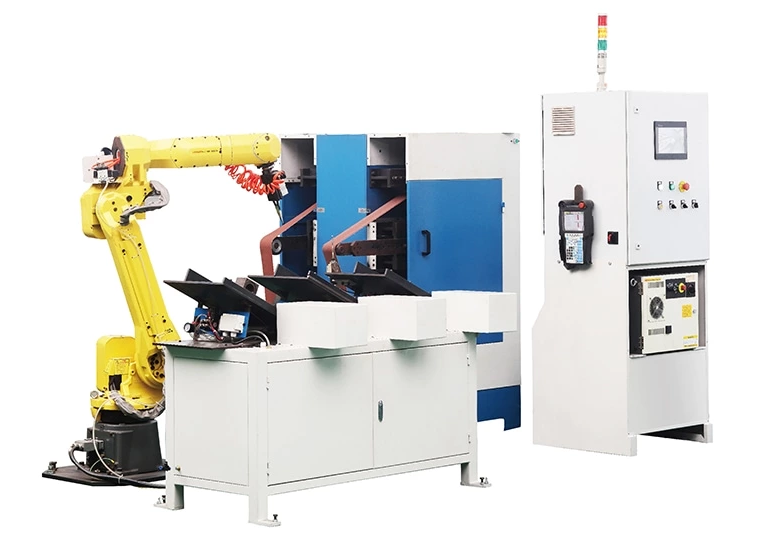
Simple Automation Work Station
2. Flexible Automation
Flexible automation systems are capable of adapting to different product designs and production volumes. They utilize programmable robots and advanced control systems to handle variability.
- Typical Applications: Industries requiring customization, small batch sizes, or frequent product changes.
- Advantages: High adaptability, reduced downtime during product changeovers.
- Limitations: Higher initial investment and potential complexity in programming and maintenance.
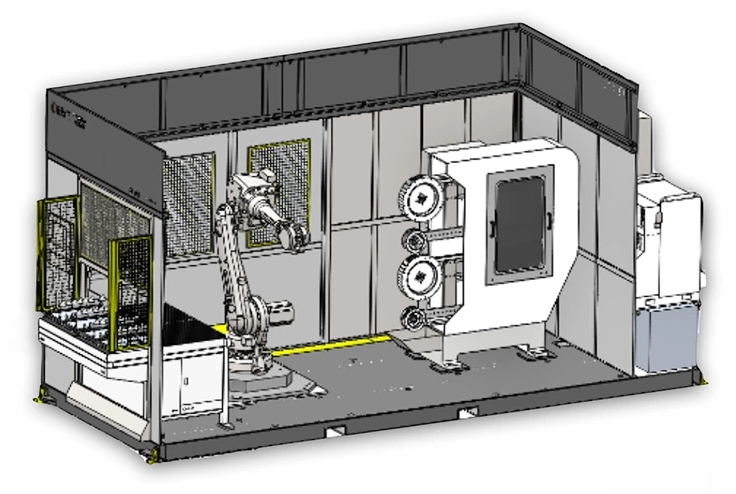
Automation Robitic Work Station
3. Hybrid Automation
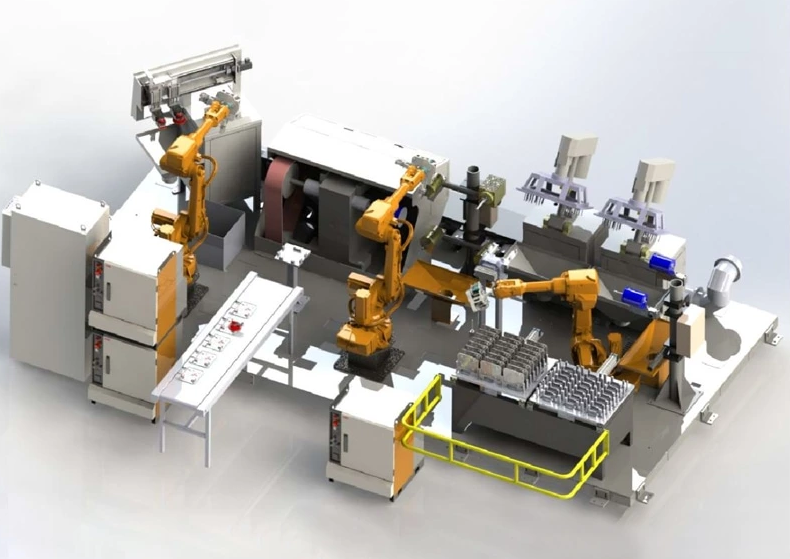
Hybrid automation combines aspects of both fixed and flexible automation, offering a balance between high efficiency and adaptability. It integrates robotic systems with modular configurations to handle varied tasks.
- Typical Applications: Industries requiring both mass production and periodic customization.
- Advantages: Optimized production rates with greater flexibility.
- Limitations: Requires strategic planning to balance cost and complexity.
Key Considerations in Selecting Automated Grinding Solutions
1. Workpiece Characteristics
- Shape, Size, and Material: The geometry and material properties of the workpiece influence the choice of grinding equipment and parameters.
- Complexity and Precision Requirements: Complex shapes or tight tolerances may necessitate advanced robotic systems with precise control capabilities.
2. Production Volume and Batch Size
- High-Volume Production: Justifies investment in fixed automation due to economies of scale.
- Low-Volume, High-Mix Production: Benefits from flexible automation to accommodate variability without significant retooling.
3. Quality and Tolerance Specifications
- Consistency and Precision: Automated systems can maintain uniform quality, essential for meeting stringent industry standards.
- Surface Finish Requirements: Specific applications may demand particular surface finishes, influencing the selection of grinding tools and processes.
4. Integration with Existing Processes
- Compatibility with Other Systems: Ensuring new automation solutions align with existing workflows and equipment.
- Scalability: Allowing for future expansion and upgrades to accommodate evolving production needs.
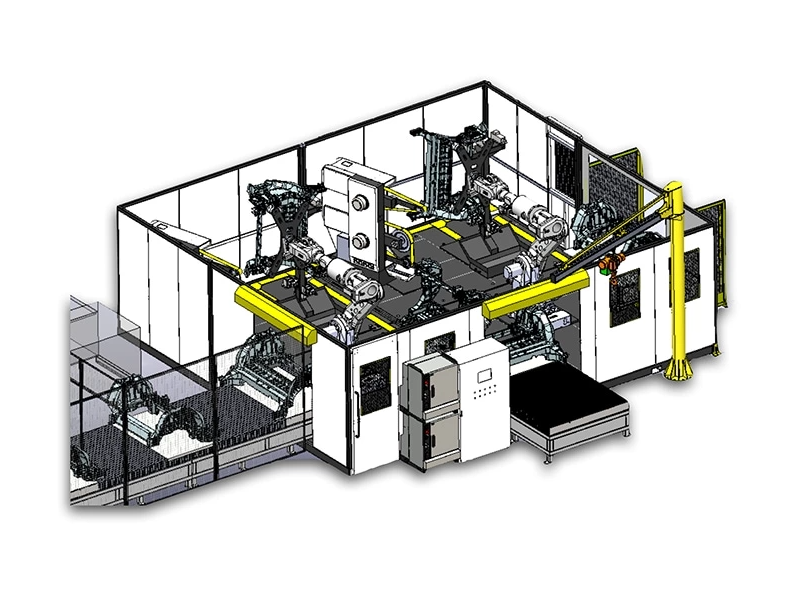
Integrated Fully Automatic Robotic Workstation
Critical Factors in Process Planning for Automated Grinding
1. Defining Grinding Objectives
- Dimensional Accuracy: Ensuring the workpiece meets specified measurements.
- Surface Integrity: Achieving the desired surface properties without inducing defects.
2. Robotic Path Planning
- Trajectory Optimization: Developing efficient tool paths to minimize cycle time and wear.
- Collision Avoidance: Ensuring the robot operates safely within its environment.
3. Selection of Abrasives and Tools
- Material Compatibility: Choosing abrasives that are suitable for the workpiece material to achieve optimal results.
- Tool Geometry and Specifications: Selecting tools that align with the desired surface finish and material removal rates.
4. Implementation of Force Control Technology
- Active vs. Passive Force Control: Deciding between systems that actively adjust force in real-time versus those with preset compliance.
- Sensor Integration: Utilizing sensors to monitor and adjust the applied force, ensuring consistent contact and quality.
5. Environmental and Safety Considerations
- Dust and Debris Management: Implementing dust extraction and filtration systems to maintain workplace safety.
- Noise Reduction: Designing enclosures or noise-dampening solutions to minimize sound pollution.
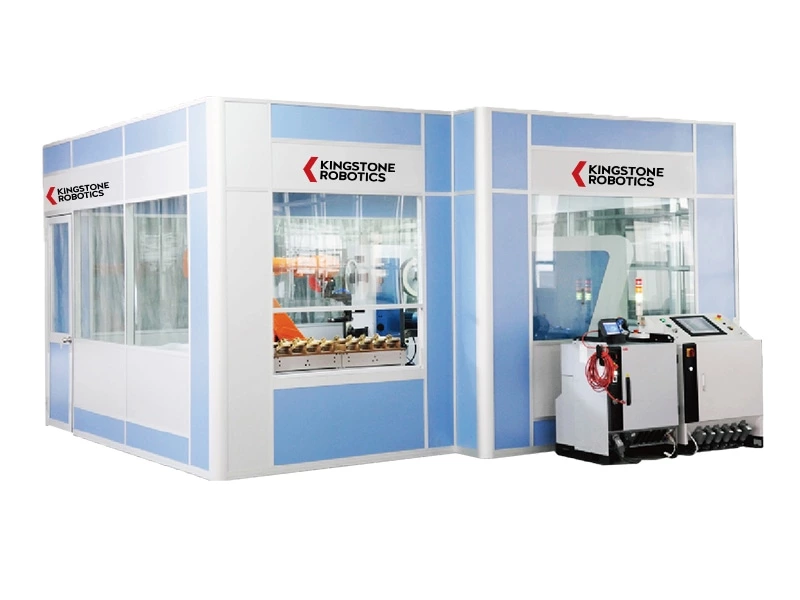
Enclosed Workstation
Case Studies of Automated Grinding Implementations
Case Study 1: Copen Machine’s Integration of Automated Grinding and Swiss-Turning
- Background: Copen Machine, founded in 1978 in Akron, Ohio, evolved from a small job shop into a full-service machining and fabrication provider specializing in high-volume precision parts.
- Solution: To achieve reliable high-volume production, the company implemented 24-hour operations combining CNC Swiss-style turning machines with automated CNC cylindrical grinding operations.
- Outcome: This integration enhanced production efficiency and precision, enabling Copen Machine to meet increasing demands and maintain competitiveness.
Case Study 2: Robotic Grinding of Small Parts by MESH Automation
- Background: A manufacturer required multiple grinding machines for small castings, aiming for efficient tray loading and minimal operator intervention.
- Solution: MESH Automation employed their MACGrind platform, integrating pre-engineered belt/wheel compensation stands, reamers, and pencil grinding stands, along with a gripper auto tool changer and regrip station.
- Outcome: The system achieved over 90% efficiency, reducing labor costs and improving consistency in the grinding process.
Case Study 3: Globe Grinding’s Transition to Automation
- Background: Globe Grinding sought to increase production without adding personnel by transitioning to automation.
- Solution: The company planned to integrate automation into their grinding processes, building upon their use of CNC technology since 2000.
- Outcome: This transition aimed to enhance efficiency and maintain high-quality standards in their operations.
KS Robotics’ Expertise in Automated Grinding Solutions
1. Customized Solution Development
- Client Needs Assessment: Conducting thorough analyses to understand specific requirements and constraints.
- Tailored System Design: Developing solutions that align with the client’s production goals and operational environment.
2. Integration and Implementation
- Seamless Integration: Ensuring new systems are compatible with existing production lines and processes.
- Comprehensive Training: Providing training programs to equip staff with the necessary skills to operate and maintain the new systems.
3. Continuous Support and Optimization
- Ongoing Maintenance: Offering regular system check-ups and updates to maintain optimal performance.
- Process Optimization: Identifying opportunities for further improvements in efficiency and quality.
The Future of Automated Grinding: Smarter, Safer, and More Sustainable
Automated grinding technology is rapidly advancing, pushing the limits of what’s possible in precision finishing. As manufacturers face rising demands for accuracy, speed, and cost-efficiency, the integration of smarter, more adaptive systems is becoming essential. AI-driven control, real-time feedback, and Industry 4.0 integration are reshaping how grinding tasks are performed—making systems more intelligent, efficient, and scalable.
Emerging Trends Shaping the Future
- AI and Machine Learning Integration
Adaptive algorithms enable real-time parameter adjustment and predictive maintenance, reducing downtime and improving process reliability. - Advanced Vision Systems
Cameras and optical sensors enhance defect detection and surface analysis, ensuring consistent quality and faster corrective action. - Sustainable Manufacturing Practices
From low-emission abrasive materials to energy-efficient drives, environmental considerations are becoming central to grinding system design. - Collaborative Robotics (Cobots)
Cobots allow humans and machines to work side by side, enabling flexible grinding operations with improved safety and ease of use.