Robotic grinding and polishing solution for zinc alloy faucet bodies. Suitable for removing casting marks and improving surface consistency before plating or final finishing. Customized according to workpiece shape, finish requirement and output.
Parameter
Specification
Application
Zinc Alloy Faucet Body
Process
Robotic Grinding and Polishing
Workpiece Material
Zinc Alloy
Surface Condition
As-cast / pre-finishing
Workpiece Gripping
Internal gripping by robotic end effector
Surface Result
Smooth and reflective finish
System Type
Customized robotic work station
Robot Brand
ABB (optional / customizable)
Final system configuration is determined according to the actual workpiece, required surface finish and production capacity.
Zinc Alloy Faucet Robotic Grinding and Polishing
Zinc alloy faucet bodies often require several surface-finishing steps before plating or final decorative finishing. The original casting may contain parting lines, local roughness, casting marks and other surface irregularities that need to be removed without changing the intended contours of the part.For this application, Kingstone Robotics develops the robotic grinding and polishing process around the actual faucet body rather than using a fixed standard program. Workpiece shape, casting condition, surface requirements, abrasive selection and production volume are considered together before the final robotic cell is configured.
From Cast Surface to Polished Finish
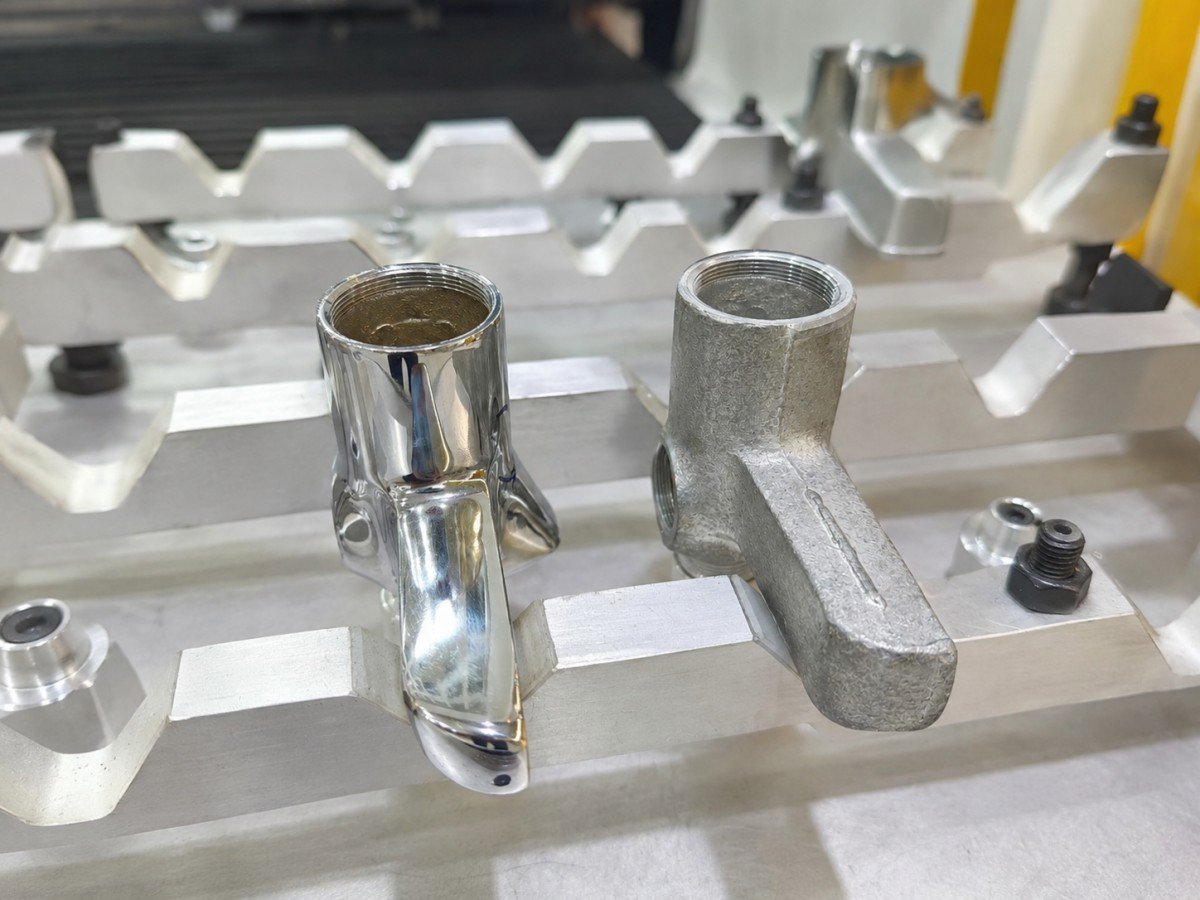
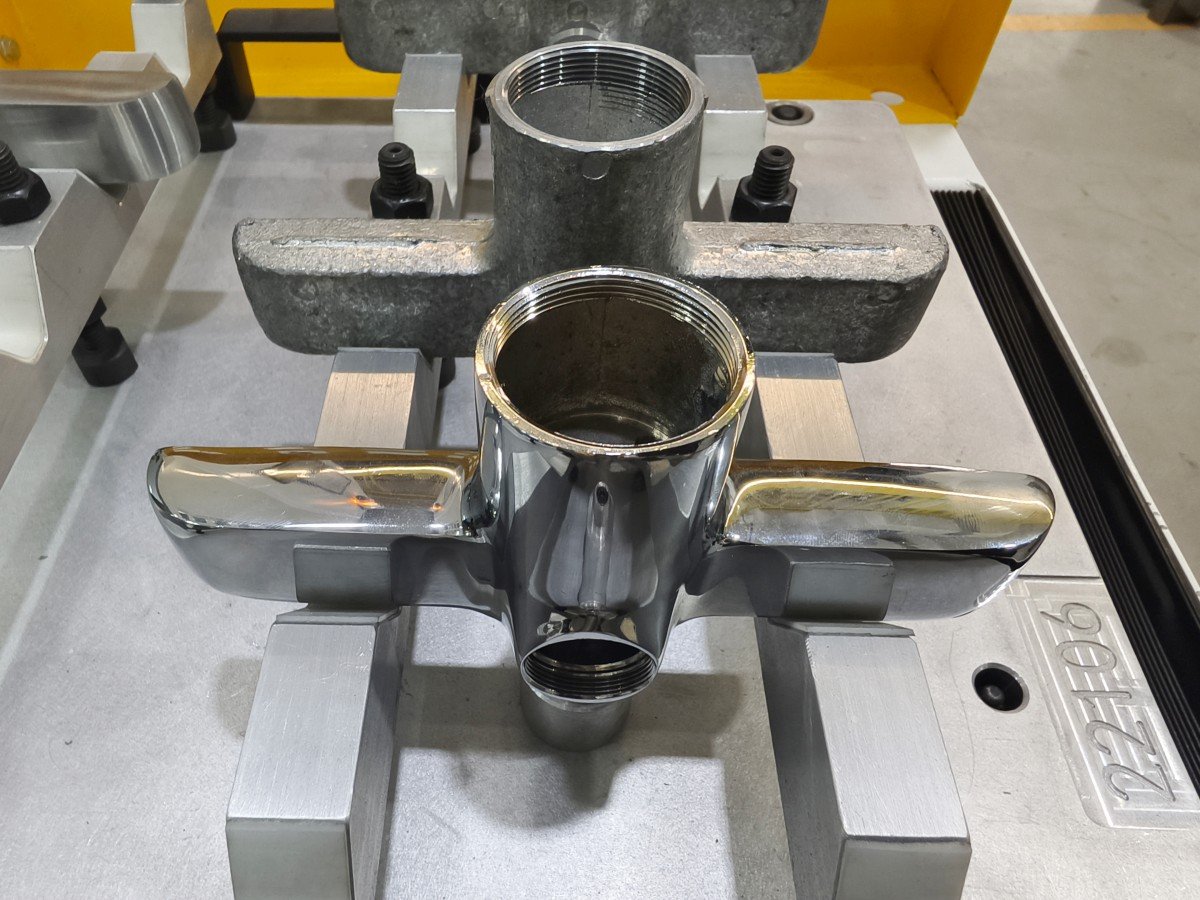
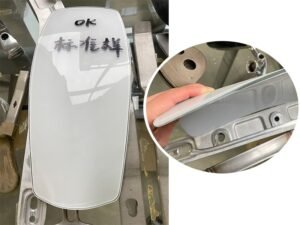
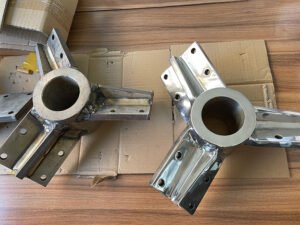
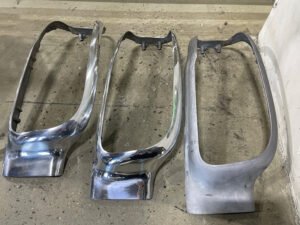
The samples shown here illustrate the difference between the original zinc alloy casting and the part after surface finishing.The unfinished component retains the rough texture of the casting process. After grinding and polishing, the visible surfaces become smoother and more reflective, preparing the component for subsequent plating or other decorative surface treatment.
Because a faucet body contains curved faces, transitions, edges and several changes in direction, the robot needs to continuously adjust the orientation of the workpiece during processing.This is different from simply holding a flat component against one abrasive surface.
Robot-Held Workpiece Processing
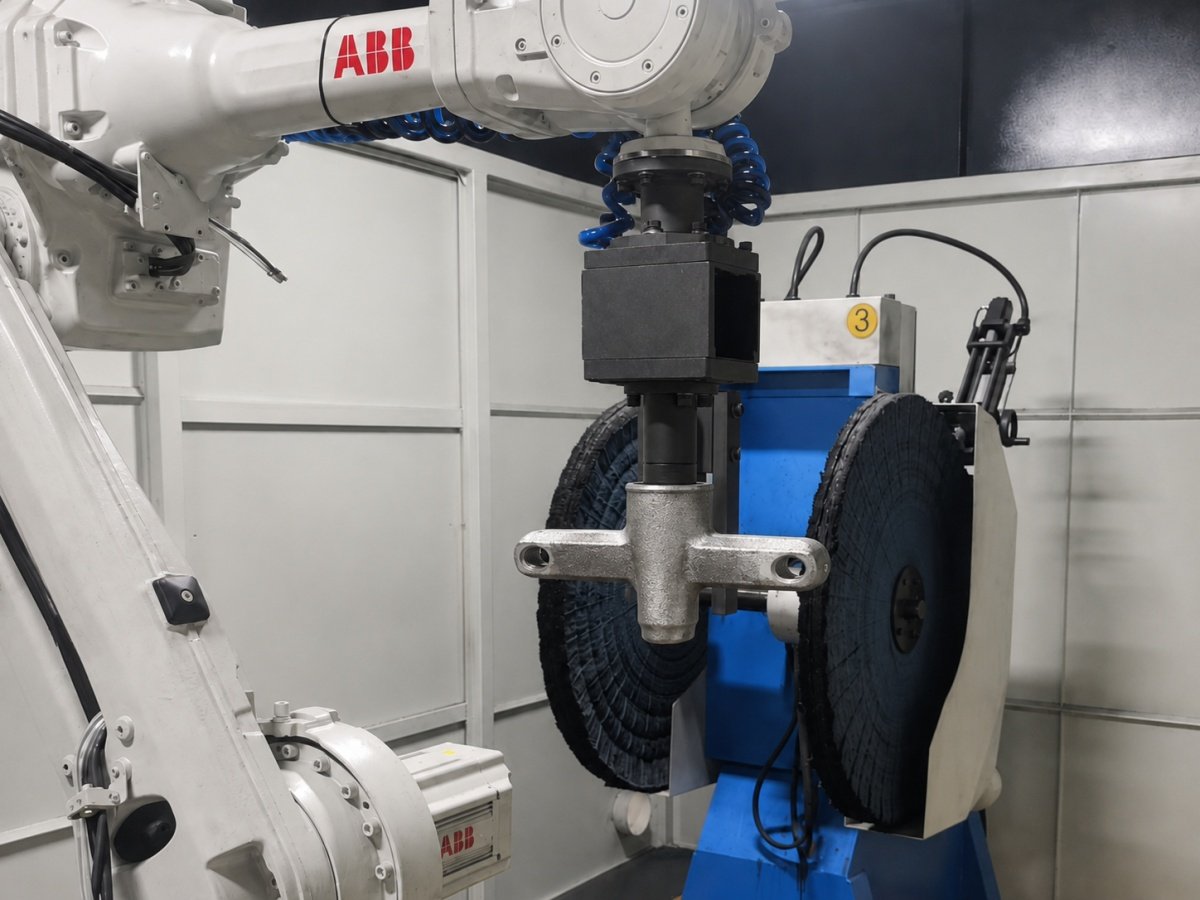
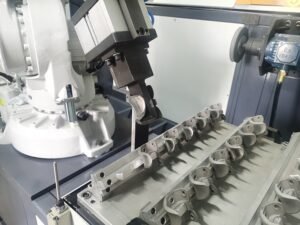
In this application, the faucet body is not fixed on a stationary fixture while a robot-mounted tool moves around it.Instead, the robot handles the workpiece.The faucet bodies are first arranged in a loading tray. The robot picks up an individual component and secures it through the internal opening of the faucet body. The gripping head remains inside the part while the robot carries the workpiece through the required grinding and polishing operations.With the workpiece held by the robot, its position and angle can be changed continuously as different surfaces are presented to the abrasive belt or polishing wheel.This approach provides the flexibility needed to process curved faucet bodies and other sanitary hardware with complex external surfaces.
Typical Grinding and Polishing Process
The exact sequence depends on the initial casting condition and the required final surface.A typical process may include:
Removal of casting marks and parting lines
Rough belt grinding
Intermediate sanding
Fine surface preparation
Buffing or polishing
Final surface inspection
Not every faucet requires all of these stages.Before a production system is finalized, actual workpieces should be tested to determine the suitable abrasives, contact conditions, robot paths and number of finishing steps.
Internal Gripping and Workpiece Handling
Reliable workpiece handling is particularly important in this type of robotic polishing cell.The gripping head enters the internal opening of the faucet body and secures the part from inside. This leaves the main external surfaces accessible for grinding and polishing while the robot controls the orientation of the workpiece.The gripping method is developed according to the actual internal geometry of the component.For a new project, we normally review the workpiece drawing and actual samples before finalizing the end-effector design.
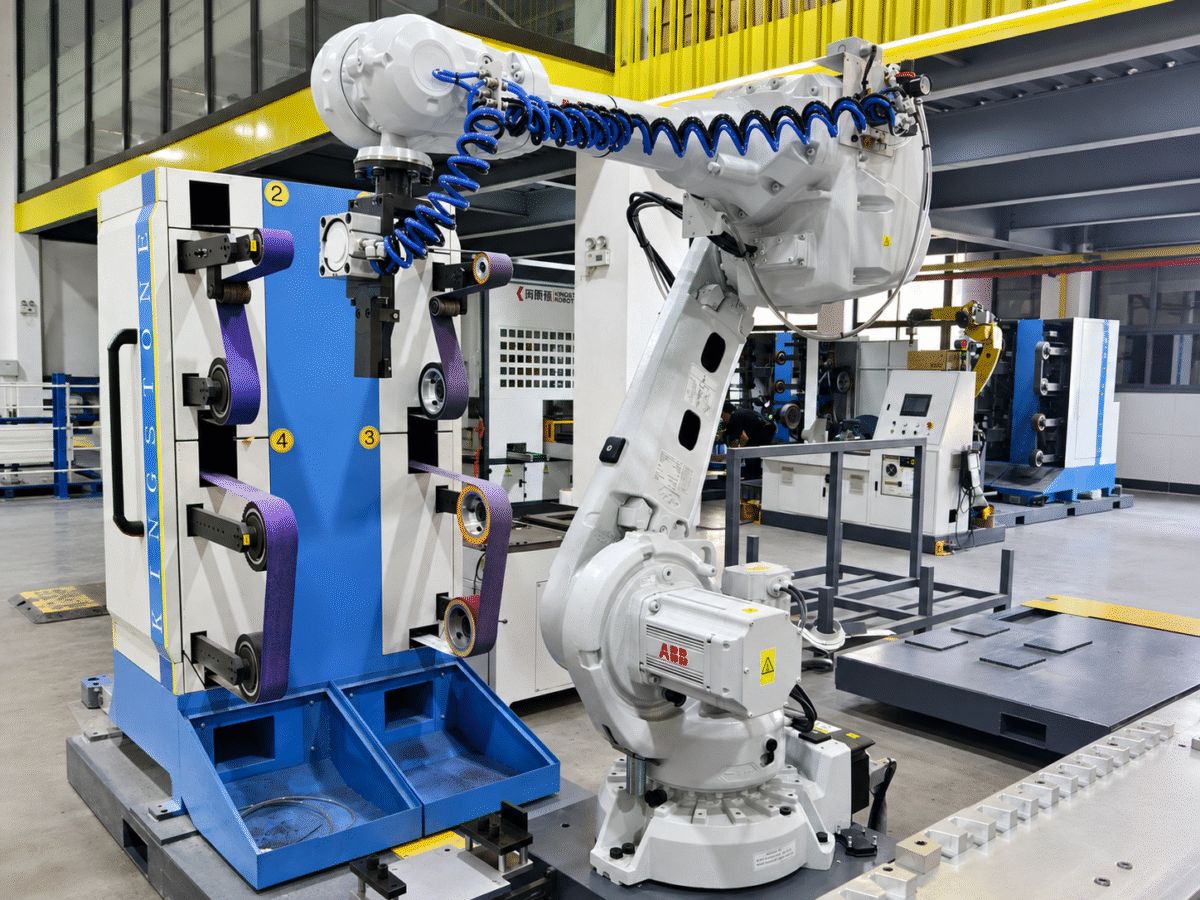
Robotic Grinding and Polishing Workstation
A complete system can be configured according to the required finishing process and production capacity.The workstation may include:
Safety enclosure and dust extraction according to project requirements
The number and type of grinding or polishing stations are selected according to the actual process rather than using one fixed configuration for every faucet.
Why Use Robotic Processing for Zinc Alloy Faucet Bodies?
Manual faucet polishing requires an operator to continuously rotate the workpiece, change the contact angle and judge how much material should be removed from different areas.For repetitive production, these operations can be converted into defined robotic paths and finishing steps.A robotic system can help manufacturers achieve:
More repeatable finishing across production batches
Stable workpiece positioning and processing paths
Less dependence on experienced manual polishing operators
Reduced operator exposure to grinding dust and repetitive work
Easier process standardization for batch production
Integration of several grinding and polishing operations in one automated cell
The objective is not simply to replace the manual movement with a robot. The grinding process, abrasives, gripping method and robot path need to be developed together.
Suitable Applications
This type of robotic grinding and polishing process can also be evaluated for:
Other cast decorative hardware with curved external surfaces
Different geometries may require different gripping heads, robot programs and finishing sequences.
What We Need for a Project Evaluation
For an initial feasibility review, it is helpful to provide:
Clear photos of the original workpiece
2D or 3D drawings
Material information
Workpiece dimensions and weight
Current manual grinding and polishing process
Required surface condition after finishing
Production quantity per shift or per day
Several actual samples for process testing, when available
A short video of the current manual polishing process is also useful because it shows which areas require the most material removal and how operators currently handle the component.
Discuss Your Faucet Polishing Project
Every faucet body has different casting conditions, surfaces and production requirements.If you are evaluating robotic grinding and polishing for zinc alloy faucet components, send us your workpiece photos, drawings and finishing requirements. Our engineering team can review the application and recommend a suitable handling, grinding and polishing process for your production.
Our core technologies—automatic constant-pressure control, multifunctional fixtures, composite polishing wheels, and a proprietary software system—enable precise, consistent finishing on complex surfaces. Our solution fills a critical gap in the surface treatment industry.