
For a zinc alloy faucet manufacturer, the quality of a chrome, nickel or other decorative finish begins well before the part enters the plating line. A die-cast faucet body may still have parting lines, local roughness, casting texture and marks left by earlier operations. If these defects are not removed evenly, they can remain visible after plating.
This is why zinc alloy faucet polishing should be treated as a controlled surface-preparation process rather than a single final buffing step. Grinding must remove the necessary defects, while fine sanding and polishing create a uniform base surface without changing the intended shape of the faucet.
In this application, the robot grips the faucet body from inside and presents its different external surfaces to the abrasive stations. The complete zinc alloy faucet robotic grinding and polishing solution is developed around the actual casting, required finish and production conditions.
Why Surface Preparation Matters Before Faucet Plating
Decorative plating adds a new surface layer, but it is not a substitute for mechanical finishing. Deep scratches, uneven transitions, visible parting lines and local waves on the base metal can affect the appearance of the plated product.
Before plating, the finishing process normally needs to create a surface that is:
- Free from visible casting seams and flash
- Smooth across curved faces and transitions
- Consistent from one production part to the next
- Suitable for the subsequent cleaning and plating process
- Finished without excessive rounding of edges or loss of design details
The goal is not to remove as much material as possible. It is to remove the correct amount from the correct areas while keeping the original contour of the faucet body.
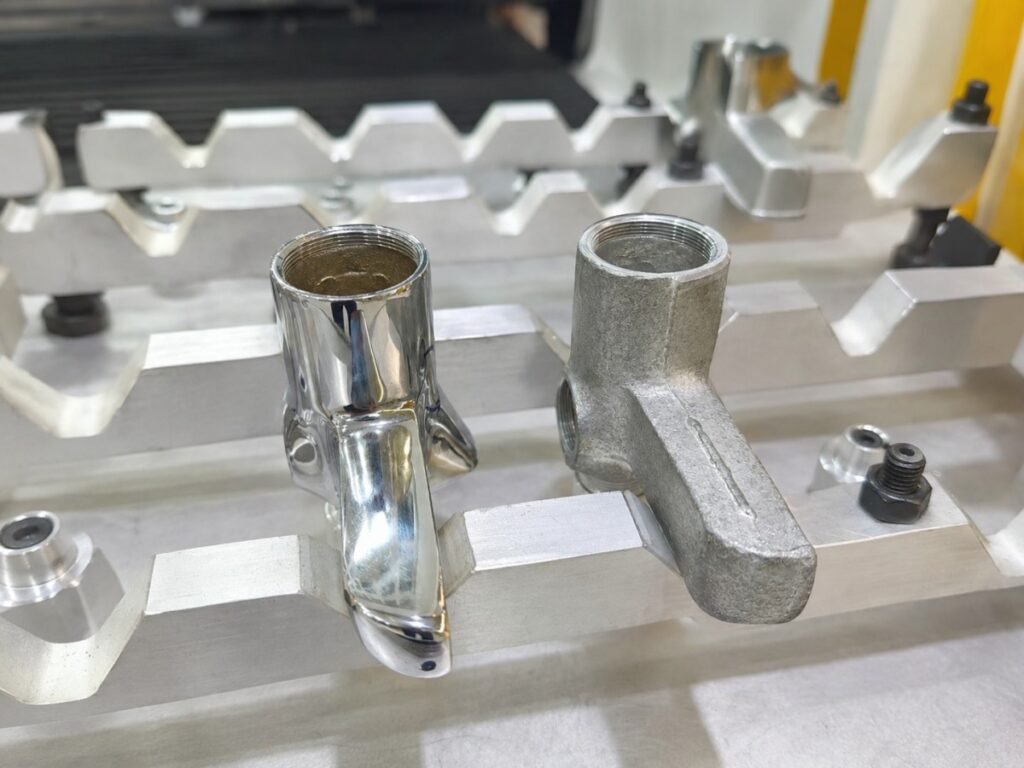
Why Zinc Alloy Faucet Bodies Are Difficult to Polish Consistently
A faucet body is not a flat component. It normally includes curved faces, changing radii, edges, neck transitions and surfaces facing several directions. During manual polishing, an experienced operator continually rotates the part, changes the contact angle and adjusts pressure by feel.
Converting this work into an automated process requires more than recording a robot path. Several factors must be developed together:
- The position and angle at which each surface contacts the abrasive
- The amount of contact pressure or compliance used at each stage
- The abrasive sequence selected for the original casting condition
- The areas that need more material removal and the areas that must be protected
- The effect of abrasive wear during a production run
- Normal variation between castings from different batches
If the contact is too aggressive, edges and design lines may be rounded or the surface may become uneven. If it is too light, casting marks and sanding lines may remain. Process testing is therefore essential before the production cell is finalized.
How Robot-Held Faucet Processing Works
For this project, the robot carries the workpiece instead of moving a robot-mounted grinding tool around a stationary faucet.
The unfinished faucet bodies are arranged in a loading tray. The robot picks up one part and inserts a customized gripping head into its internal opening. Once the component is secured from inside, the robot moves it to the required abrasive belt and polishing stations.
This internal gripping method keeps the main external surfaces accessible. The robot can continuously change the position and angle of the faucet body, presenting each curved area to the abrasive under controlled conditions.
The gripper is not a universal component. Its locating and clamping surfaces must match the internal geometry of the actual faucet body so the part remains stable throughout grinding and polishing.
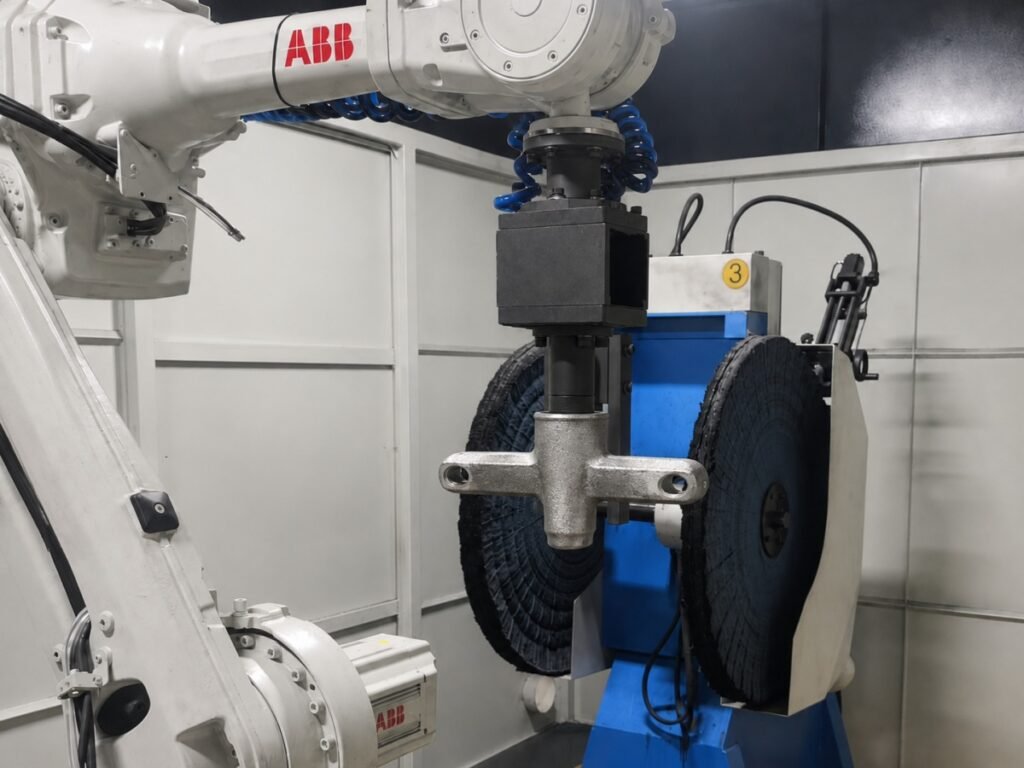
A Typical Robotic Grinding and Polishing Sequence
The exact process depends on the initial casting and the finish required before plating. A typical sequence can include the following stages.
1. Evaluate the Original Casting
The first step is to identify parting lines, flash, local high points, surface texture and any areas that must retain a defined edge or dimension. Samples from normal production are more useful than one specially selected part because they reveal realistic casting variation.
2. Rough Grinding
An abrasive belt removes the main casting seams and obvious surface irregularities. The robot controls how the faucet approaches the belt and changes its orientation as different faces are processed.
3. Intermediate Sanding and Blending
The next abrasive stage reduces the scratches left by rough grinding and blends the transitions between processed areas. This step is important on curved surfaces, where an uneven transition may remain visible after decorative finishing.
4. Fine Surface Preparation
Finer abrasives reduce the remaining sanding lines and prepare the part for polishing. Contact conditions must remain stable as the abrasive wears.
5. Buffing or Polishing
The faucet body is presented to the selected polishing wheel to create the required pre-plating surface. The final finish should be agreed using physical samples rather than vague terms such as “bright” or “mirror.”
6. Inspection
The finished part is checked for remaining casting marks, uneven reflection, missed areas and excessive material removal. Any changes to the robot path, contact condition or abrasive sequence are verified through further sample testing.
Not every faucet body needs all six stages. The process should be based on the actual incoming surface and the customer’s acceptance standard.
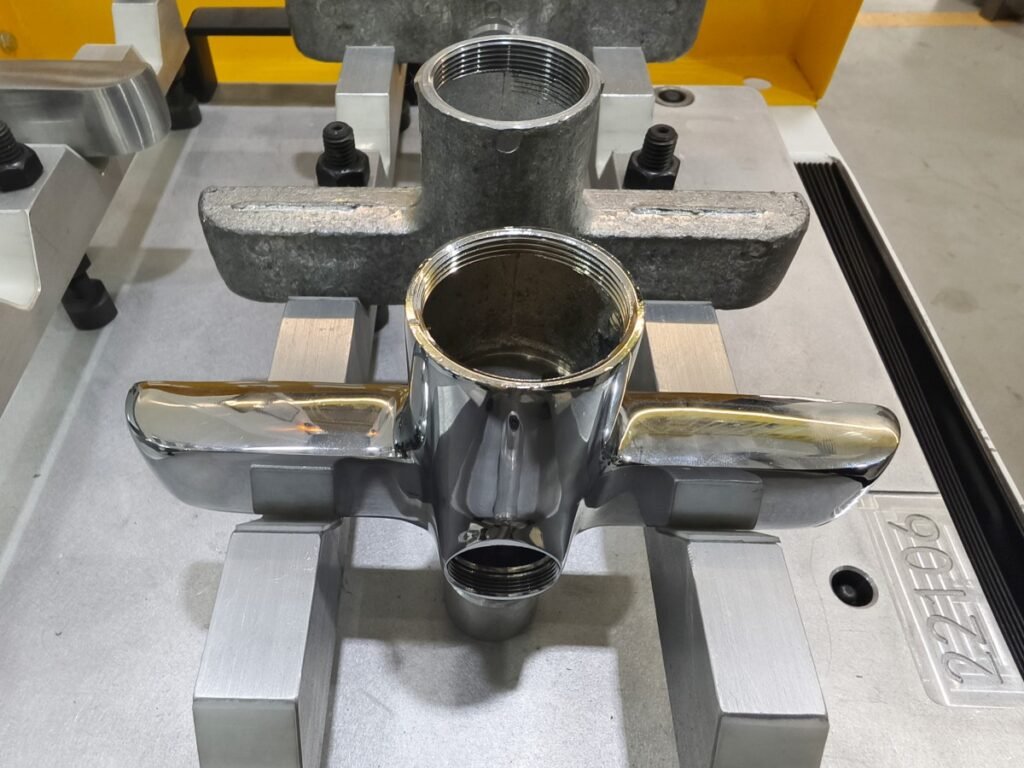
What Determines the Final System Configuration?
A robotic grinding and polishing system for faucet production is configured according to the process, not selected only by robot payload or brand.
The engineering evaluation normally considers:
- Faucet material and casting method
- Part dimensions, weight and center of gravity
- Internal geometry available for gripping
- Defects to be removed
- Required surface before plating
- Current manual abrasives and polishing compound
- Quantity per shift or per day
- Number of faucet models and changeover frequency
- Loading and unloading method
- Dust extraction, guarding and maintenance access
The final workstation may combine a six-axis industrial robot, customized internal gripper, loading tray, multi-station abrasive belt unit, polishing wheels, process controls, safety enclosure and dust extraction interface.
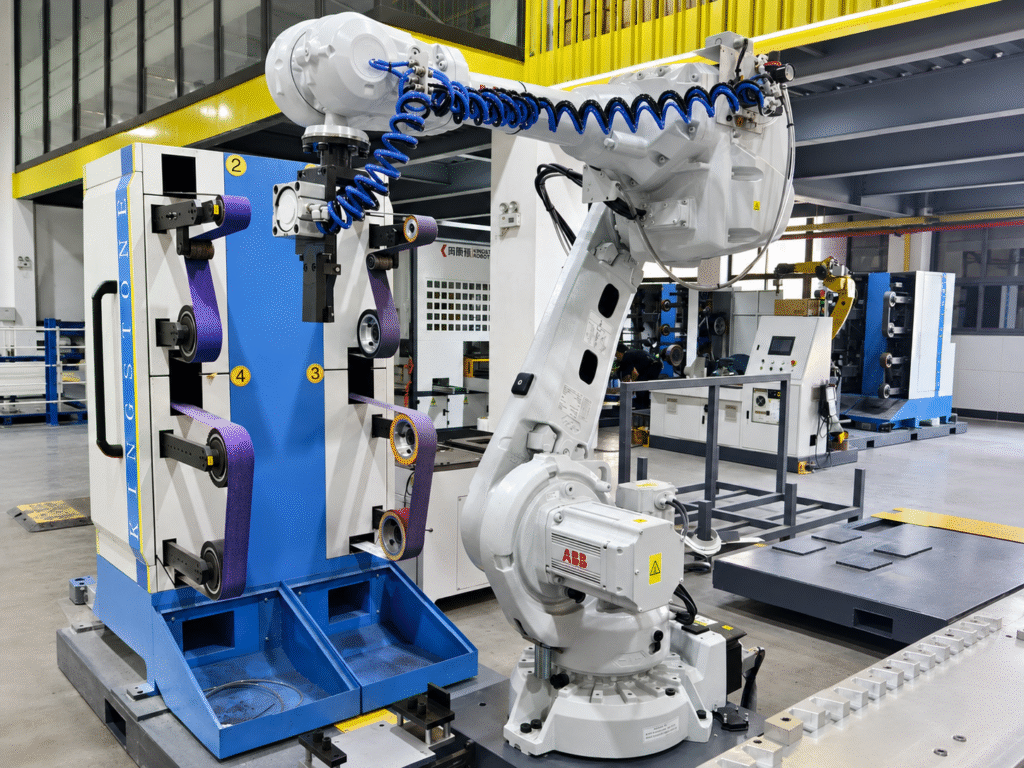
Benefits for Batch Faucet Production
Once the gripping method, abrasives and robot paths have been proven with actual samples, robotic processing can help a faucet manufacturer achieve:
- More repeatable surface preparation across production batches
- Stable processing paths and contact angles
- Less dependence on individual operator technique
- Easier standardization of multiple finishing stages
- Reduced operator exposure to grinding dust and repetitive work
- A clearer basis for inspection before plating
- Better integration of grinding and polishing within one work cell
The same automation principle can also be evaluated for mixer bodies, faucet handles, taps, spouts and other bathroom hardware polishing applications. However, different products may require their own gripping heads, programs and abrasive sequences.
Can One System Process Different Faucet Models?
In many projects, one cell can store several robot programs and use replaceable gripping heads for related products. Whether this is practical depends on how much the models differ in size, internal locating features, external geometry and finishing requirements.
Similar faucet families are usually easier to combine. Products with very different shapes or surface standards may need longer changeovers or separate process stations. Our guide to metal parts suitable for robotic polishing explains the main points that should be checked before automation.
Information Needed for a Faucet Polishing Evaluation
For an initial review, send the following information:
- Clear photos of the complete faucet body
- Close-up photos of the areas that need grinding or polishing
- A 2D or 3D drawing, if available
- Material grade, dimensions and part weight
- Photos showing the normal incoming casting condition
- Current manual finishing steps and abrasives
- Required surface before plating
- Production quantity per shift or per day
- A short video of the current manual process
- Several actual production samples for process testing
This information helps the engineering team evaluate access, gripping, abrasive stages, robot movement and the appropriate level of automation.
Frequently Asked Questions
Can one robot perform both grinding and polishing?
Yes. A robotic cell can move the workpiece between different abrasive belt and polishing stations. The required stations depend on the starting surface and the finish expected before plating.
How is the zinc alloy faucet held during processing?
In this application, a customized gripping head enters the internal opening of the faucet body. The robot holds the part from inside, leaving the main external surfaces available for grinding and polishing.
Does robotic polishing replace plating pretreatment?
No. Robotic grinding and polishing prepare the mechanical surface. The part still needs the cleaning, activation and other pretreatment steps specified by the plating process.
Can the same program be used for every faucet body?
No. Different geometry, casting variation, gripping points and surface requirements can change the program and finishing sequence. Each new model should be evaluated and tested.
Why are actual samples needed before the machine is built?
Sample testing confirms whether the defects can be removed, which abrasives are suitable, how the part should be gripped and what robot paths are required. It also provides a physical reference for the accepted finish.
Final Thoughts
Successful zinc alloy faucet polishing depends on the complete process: the original casting, internal gripper, abrasives, contact conditions, robot paths and target surface before plating.
The robot provides repeatable movement, but the finishing result comes from developing these elements together around the actual workpiece. For manufacturers producing faucet bodies in batches, this approach offers a practical way to standardize a difficult and labor-intensive operation.
If you are evaluating robotic grinding and polishing for a zinc alloy faucet, contact the Kingstone Robotics engineering team with your part photos, drawings, current process and required finish. We can review the application and arrange sample testing before recommending the final system configuration.