
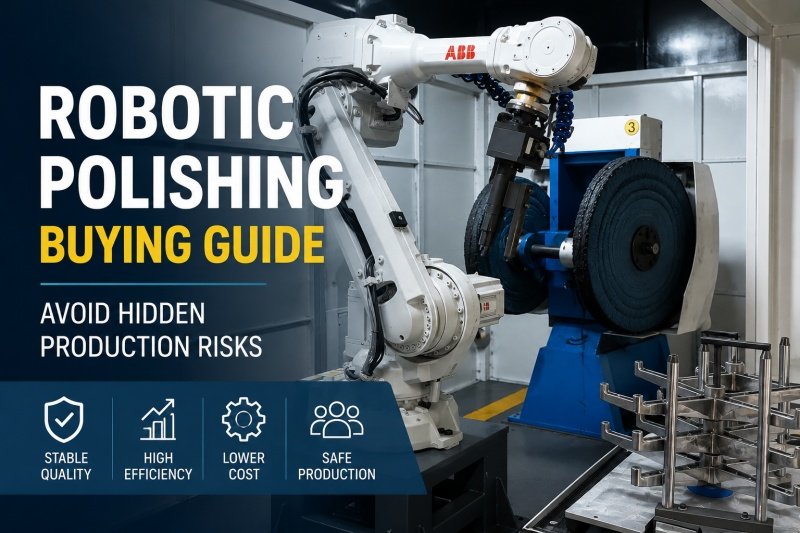
Robotic grinding and polishing have become an important solution for manufacturers that want to reduce manual labor, improve surface quality, and stabilize production. In industries such as sanitary hardware, automotive parts, die-cast components, electronics, medical parts, and general metal fabrication, manual grinding is often difficult, dusty, inconsistent, and heavily dependent on experienced workers.
However, buying a robotic polishing system is not the same as buying a standard machine. The robot arm is only one part of the solution. A successful project also depends on force control, abrasive tools, fixtures, programming, dust collection, safety protection, process testing, and long-term technical support.
In recent years, more companies have entered the robotic grinding and polishing market. Some offer attractive prices and impressive demonstration videos. But a smooth demo does not always mean the system can run stably in real production. Before investing, manufacturers should understand the hidden risks behind robotic polishing projects.
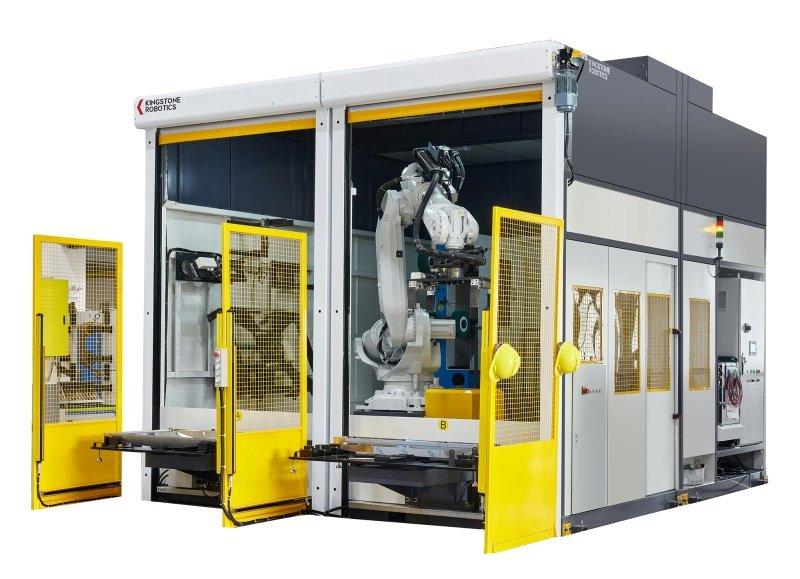
A robotic polishing system should be evaluated as a complete production solution, not only as a robot arm.
1. A Perfect Demo Does Not Always Represent Real Production
Many robotic polishing suppliers can show impressive videos. The robot moves smoothly, the surface looks bright, and the cycle time seems very fast. But demonstrations are usually made under controlled conditions.
In a demo, the workpiece may be carefully selected. The abrasive belt or polishing wheel may be new. The fixture may be adjusted many times before filming. The robot may only process one ideal sample instead of handling continuous production for days or weeks.
Real production is different.
Parts may have casting tolerances, uneven burrs, welding deformation, or inconsistent surface conditions. Abrasive tools wear during operation. Operators may load parts with small position differences. Dust, vibration, and temperature changes may also affect equipment stability.
This is why manufacturers should not only ask, “Can the system polish this sample?” A better question is:
Can the system maintain stable quality during long-term production?
Before making a decision, ask the supplier to test several real parts from different batches. If possible, request a trial that includes repeated processing, not only one perfect sample.
2. The Robot Brand Is Not the Core Technology
Some manufacturers pay too much attention to the robot brand. A well-known robot brand can be important, but it does not guarantee polishing quality by itself.
Grinding and polishing are contact-based processes. The key challenge is not only moving the robot from point A to point B. The system must control pressure, tool angle, speed, abrasive wear, overlap, surface consistency, and part tolerance.
A supplier that only understands robot integration may be able to install the robot, write a basic program, and make the machine move. But when the part surface becomes complex, or when the abrasive tool begins to wear, the system may become unstable.
A reliable robotic polishing solution should be built around the complete process:
- Material characteristics
- Surface finishing target
- Abrasive selection
- Contact force control
- Fixture repeatability
- Tool wear compensation
- Safety and dust collection
- Operator workflow
For complex polishing projects, process knowledge is often more important than the robot arm itself.
3. Weak Force Control Can Lead to Unstable Surface Quality
Force control is one of the most important factors in robotic polishing. If the contact force is too high, the system may over-grind the part, create scratches, burn the surface, or change the shape of thin-walled parts. If the force is too low, burrs, weld marks, parting lines, or rough areas may remain.
This problem becomes more serious when processing curved surfaces, irregular castings, aluminum parts, stainless steel parts, or mirror-finish components.
When evaluating a supplier, ask:
Can the system maintain stable contact force?
How does it respond to workpiece tolerance?
Can it handle curved surfaces and edge areas?
How is the polishing pressure adjusted during production?
Does the supplier have experience with similar materials and surface requirements?
A strong supplier should be able to explain the polishing logic clearly. They should not only say “our robot has force control.” They should explain how the system controls contact pressure in real production.
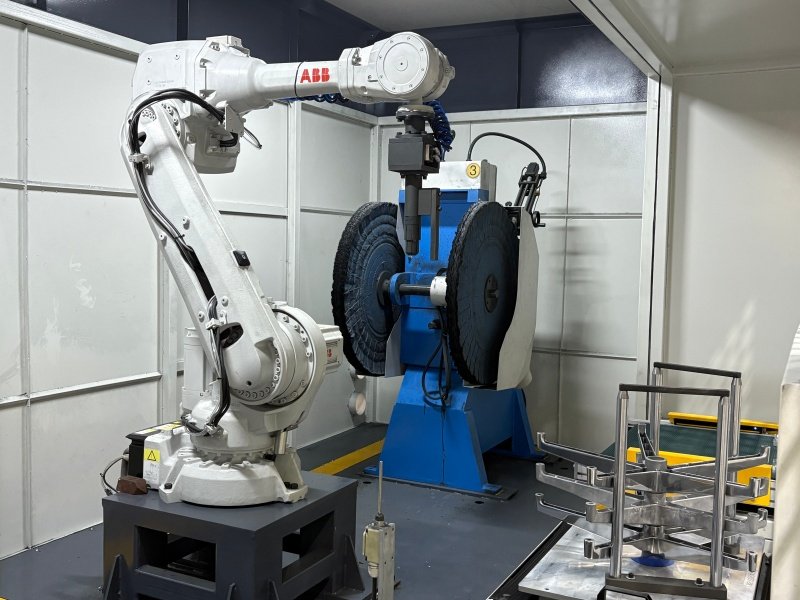
Stable contact force is one of the key factors for consistent robotic polishing quality.
4. Tool Wear Is Often Underestimated
Abrasive belts, flap wheels, cloth wheels, brushes, and grinding heads all change during use. A new abrasive tool cuts differently from a worn one. If the system uses the same parameters from the first part to the last part, the finishing result may become inconsistent.
This is a common hidden risk in robotic grinding and polishing.
At the beginning, the tool may remove material too aggressively. After some time, the same tool may become dull, clogged, or uneven. The surface quality may drop, cycle time may increase, and operators may need to make frequent adjustments.
Before choosing a robotic polishing system, ask:
How does the system manage abrasive wear?
Is there a tool replacement reminder?
Can the process compensate for tool wear?
How does the operator know when to change the abrasive?
Will the supplier help define the consumable usage standard?
For mass production, tool wear management directly affects quality, cost, and stability. A low-cost system without a clear abrasive strategy may become expensive during long-term operation.
5. Dust Collection and Safety Design Cannot Be Treated as Optional
Grinding and polishing can generate dust, sparks, noise, and heat. For metal parts, especially aluminum, magnesium, titanium, stainless steel, and other materials, dust control and safety protection are critical.
Some low-price systems reduce cost by simplifying the enclosure, dust collection, electrical protection, safety interlocks, or maintenance design. These parts may not look important during quotation, but they become very important after installation.
A robotic polishing cell should be designed as a safe production system, not only as a robot with a polishing wheel.
Manufacturers should check:
Is the polishing area enclosed?
Is dust collected close to the source?
Are doors, interlocks, and emergency stops properly designed?
Is the system suitable for the material being processed?
Is there enough space for maintenance and tool replacement?
Does the supplier understand local safety and environmental requirements?
A safe system protects both the operator and the factory. It also reduces downtime, cleaning problems, and long-term maintenance risks.
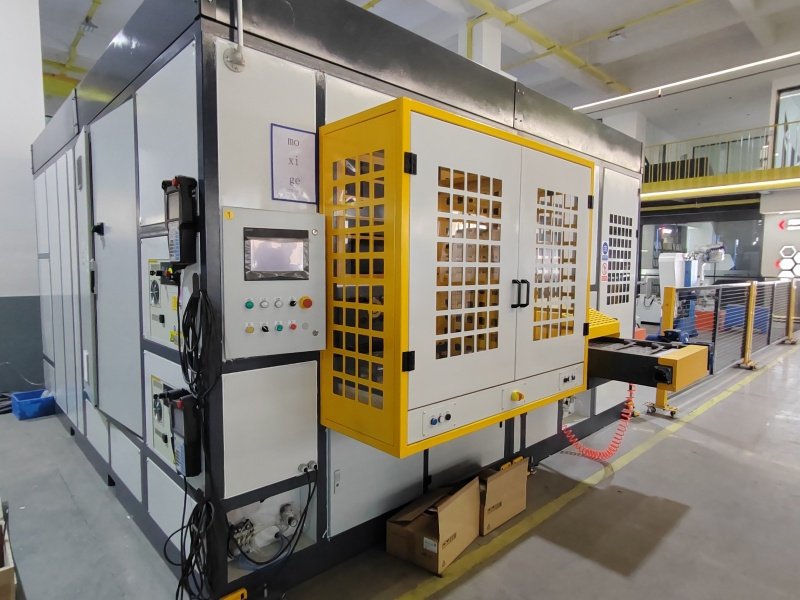
Dust collection, enclosure design, and safety protection should be considered from the beginning of the project.
6. Overpromising “Fully Automatic” Solutions Can Create Disappointment
Robotic polishing technology is improving quickly. Vision systems, offline programming, force control, and process databases can all make automation more flexible. But manufacturers should be cautious when a supplier promises that the system can automatically handle any product without testing, programming, or process adjustment.
In reality, polishing still depends heavily on the actual part, surface requirement, material, abrasive tool, fixture, and production target.
For many projects, the best approach is not to expect one machine to solve everything immediately. A more practical approach is to start with a clear process target:
Which part should be automated first?
What surface quality is required?
What areas are difficult for manual polishing?
What cycle time is acceptable?
How many product types need to be changed over?
What level of operator involvement is realistic?
A good supplier will not only promise automation. They will help define a practical automation path based on your parts and production conditions.
7. A Low Purchase Price May Increase Long-Term Cost
It is natural to compare prices when buying equipment. But for robotic grinding and polishing systems, the lowest price is not always the lowest cost.
A system that looks cheaper at the beginning may create higher long-term costs if it has poor stability, weak dust collection, high abrasive consumption, low yield rate, frequent downtime, or limited service support.
The real cost of a robotic polishing project includes:
Equipment purchase price
Installation and commissioning time
Operator training
Consumable cost
Maintenance cost
Production downtime
Rework and scrap rate
Future process adjustment
After-sales service response
Manufacturers should evaluate the total cost of ownership, not only the initial quotation. A stable system with better process engineering may create higher value over several years of production.
8. Delivery and After-Sales Support Matter More Than Many Buyers Expect
Robotic grinding and polishing projects are often customized. Even when the machine is installed, the project may still need process optimization during trial production. If the supplier lacks experienced engineers, standardized delivery methods, or responsive after-sales support, the customer may face long delays and unstable production.
Before placing an order, manufacturers should ask:
Who will be responsible for installation and commissioning?
How long will process testing take?
What training will operators receive?
Can the supplier provide remote support?
How quickly can spare parts be supplied?
Can the supplier help when the customer changes product models?
A robotic polishing system should be supported throughout its lifecycle. The supplier should not disappear after delivery.
9. What Manufacturers Should Check Before Buying
Before choosing a robotic grinding and polishing supplier, manufacturers should focus on practical evidence instead of only brochures, videos, or low prices.
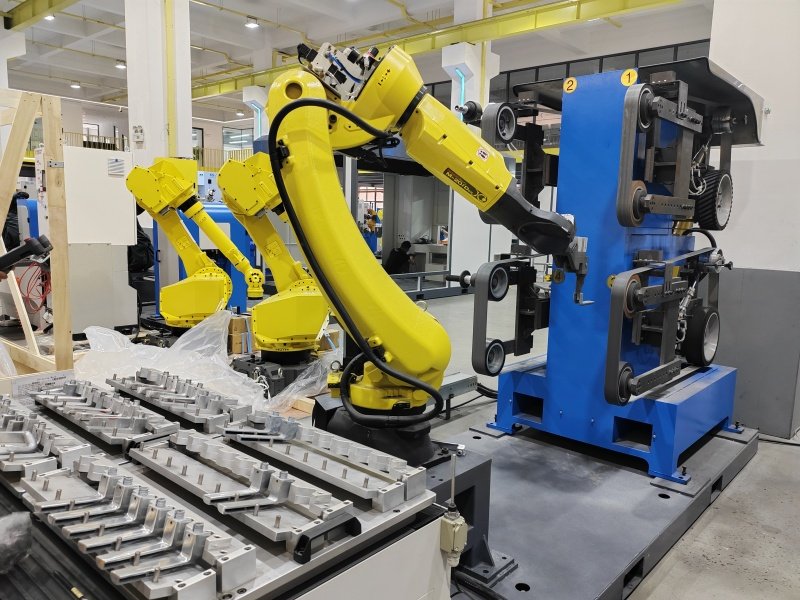
Real part testing helps define the right tooling, fixture, polishing path, and process parameters.
A useful checklist includes:
Can the supplier test your real parts?
Can they explain the polishing process clearly?
Do they understand your material and surface requirement?
Can they design proper fixtures and tooling?
How do they manage abrasive wear?
Is the dust collection and safety design suitable?
Do they have similar application experience?
Can they support installation, training, and process adjustment?
Can the system be expanded or modified in the future?
These questions help identify whether the supplier is only selling a machine or truly providing a production-ready automation solution.
Conclusion: Choose a Production Partner, Not Just a Robot Supplier
Robotic grinding and polishing automation can bring major benefits, including lower labor dependence, more stable surface quality, improved production efficiency, and safer working conditions. But these benefits only appear when the system is designed around real production needs.
A reliable robotic polishing system should combine robot motion, force control, abrasive process knowledge, fixture design, safety protection, dust collection, programming, and after-sales support. The best supplier is not necessarily the cheapest one, but the one that can help your factory achieve stable production over the long term.
At Kingstone Robotics, we provide robotic grinding, polishing, buffing, and deburring solutions designed around customer parts, surface requirements, and production targets. If you are planning to automate your surface finishing process, send us your part photos, drawings, or samples. Our engineering team can help evaluate the process and recommend a suitable robotic polishing solution.