
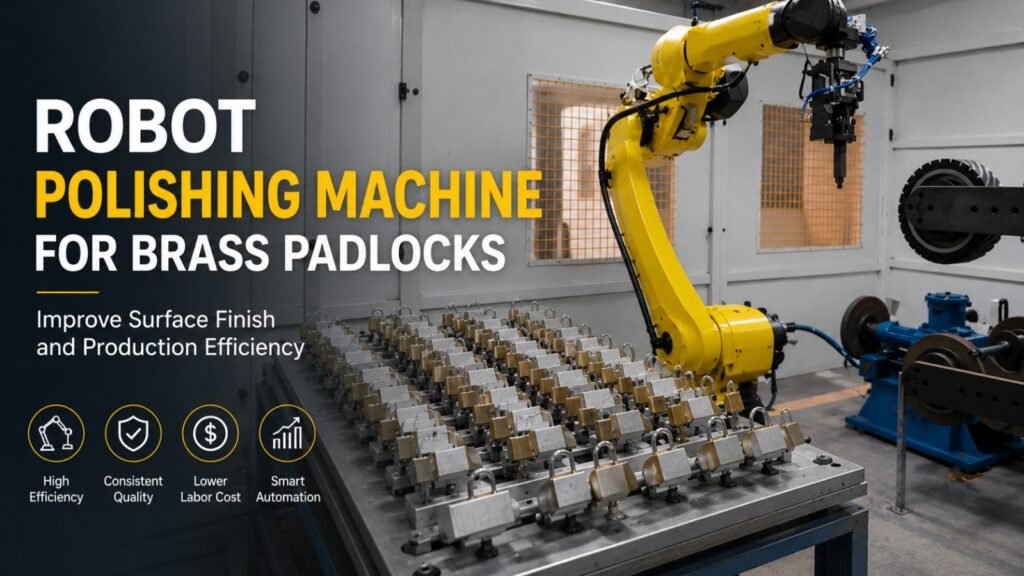
Brass padlocks are widely used in residential, commercial, and industrial security products. Their appearance directly affects product value, while consistent surface quality is essential before electroplating, coating, or packaging.
Traditional manual polishing often struggles with inconsistent finishes, unstable production speed, and increasing labor costs. As manufacturers seek higher productivity and better quality control, robotic polishing has become a practical solution.
This project demonstrates how an automated robot polishing machine helps manufacturers improve efficiency while delivering a more consistent finish on brass padlocks.
Challenges of Manual Brass Padlock Polishing
Many lock manufacturers still rely on skilled operators to polish brass lock bodies.
However, manual polishing introduces several common challenges:
- Surface quality varies between operators.
- Production speed depends on worker experience.
- Labor costs continue to increase.
- Dust and repetitive work create difficult working conditions.
- Stable quality becomes difficult during large production runs.
These issues become even more significant when manufacturers need to produce thousands of padlocks every day.
Automated Robot Polishing Solution
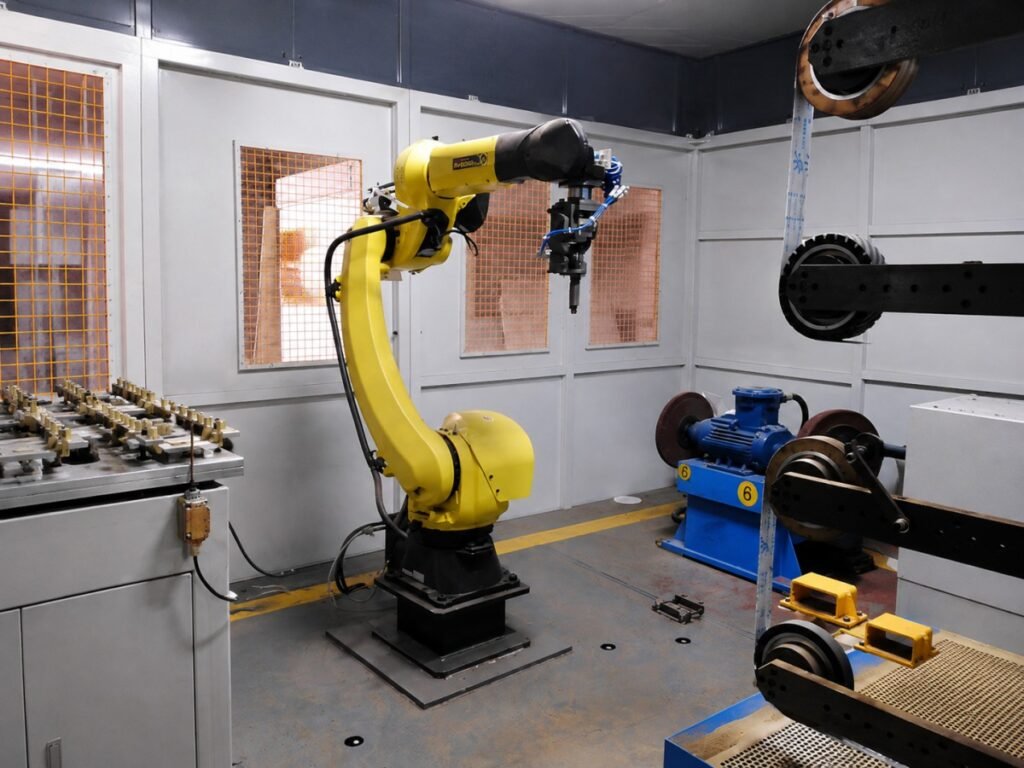
The robotic polishing system is designed specifically for high-volume brass padlock production.
Each lock body is securely positioned on a custom fixture before entering the polishing station. The industrial robot follows a programmed polishing path with consistent force and speed, ensuring every workpiece receives the same surface treatment.
The system can automatically handle multiple polishing stages while reducing manual intervention throughout the production process.
Key advantages include:
- Stable polishing pressure
- Repeatable polishing paths
- Reduced operator dependence
- Continuous production capability
- Improved process consistency
Custom Fixtures Improve Production Efficiency
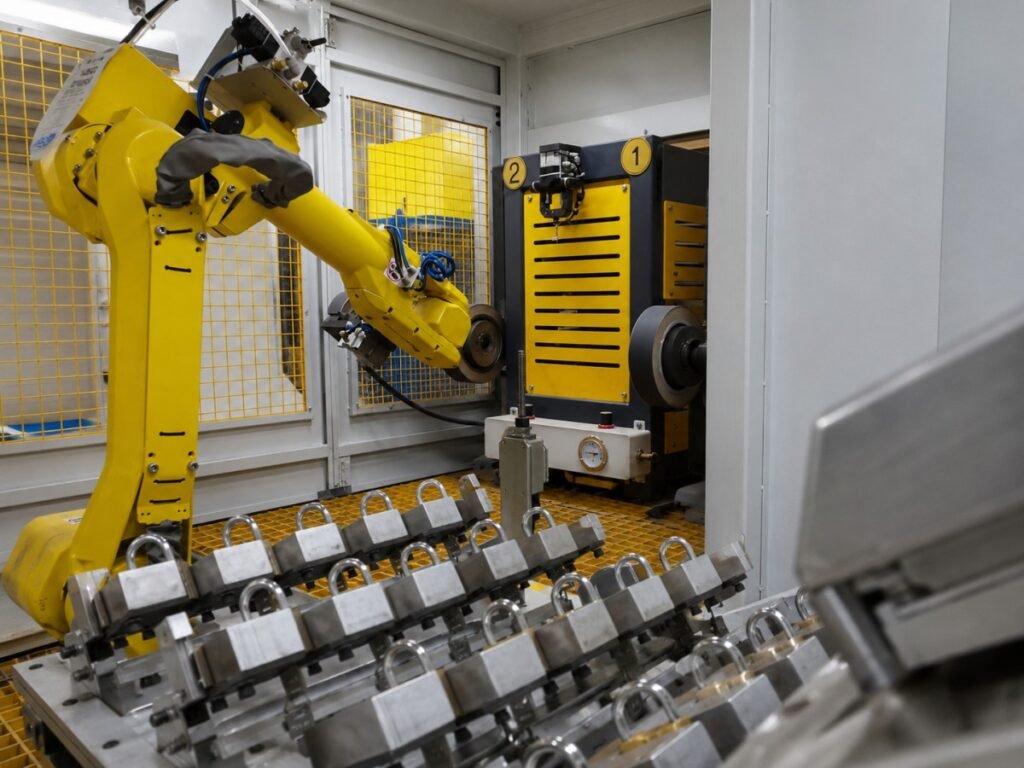
A dedicated fixture holds multiple brass padlocks simultaneously, allowing the robot to process a complete batch in one cycle.
Custom tooling ensures every lock body remains accurately positioned throughout polishing, minimizing dimensional variation while improving cycle efficiency.
This batch-processing approach significantly increases machine utilization compared with polishing individual workpieces manually.
Consistent Surface Quality
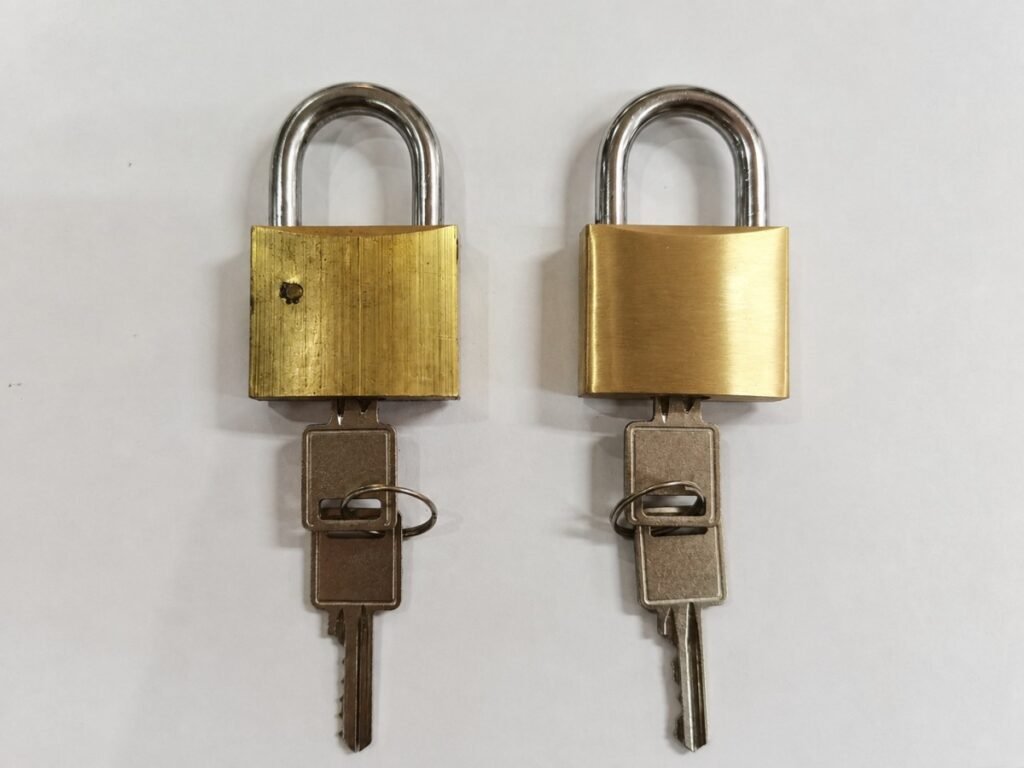
One of the biggest advantages of robotic polishing is repeatability.
As shown above, the brass padlock after robotic polishing presents:
- More uniform brushing lines
- Cleaner surface appearance
- Reduced polishing marks
- Better preparation for electroplating or coating
- Improved overall product consistency
Because the polishing parameters remain identical for every cycle, manufacturers can achieve stable quality across thousands of parts.
Fully Enclosed Robotic Cell
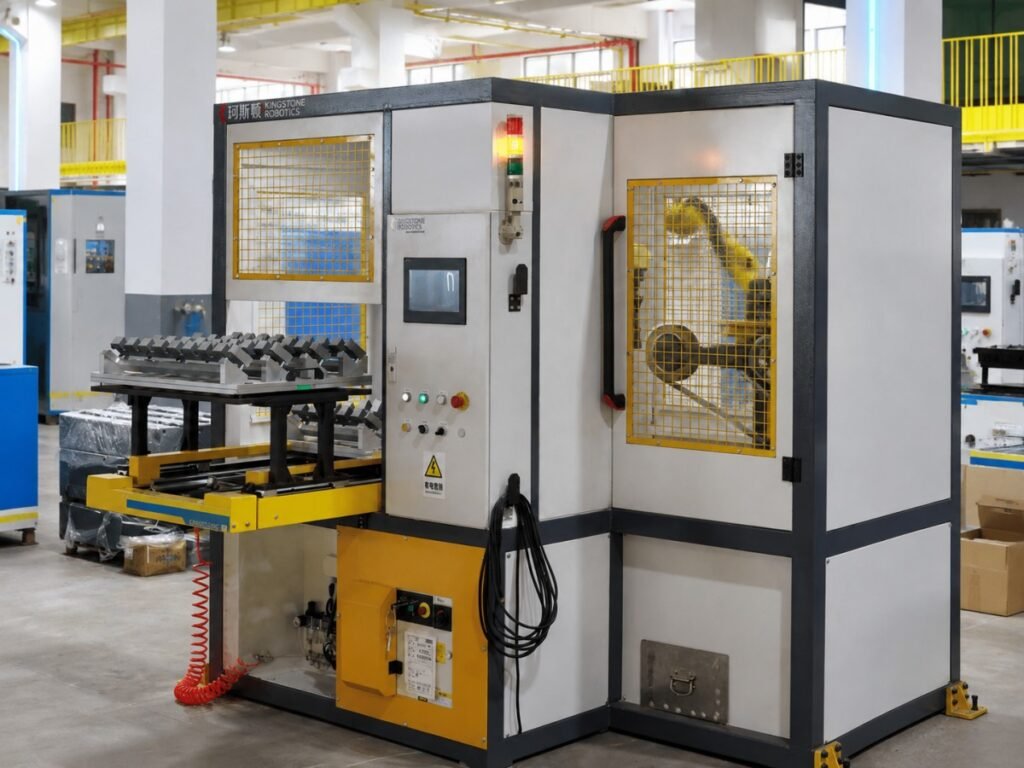
The polishing system is installed inside a fully enclosed safety cell equipped with industrial robot control, polishing units, and custom fixtures.
The enclosed design offers several benefits:
- Enhanced operator safety
- Cleaner working environment
- Better dust containment
- Easier production management
- Stable automated operation
Depending on customer requirements, the system can also be integrated with automatic loading, unloading, vision inspection, or conveyor systems.
Suitable Applications
Although this project focuses on brass padlocks, the same technology is widely used in door hardware applications, including:
- Door locks
- Door handles
- Brass fittings
- Zinc die-cast parts
- Bathroom hardware
- Furniture hardware
- Decorative metal components
Different polishing wheels, fixtures, and robot programs can be configured according to the product geometry and required surface finish.
Why Manufacturers Choose Robotic Polishing
Compared with manual polishing, an automated robotic solution offers several long-term advantages.
| Manual Polishing | Robot Polishing |
|---|---|
| Quality depends on workers | Stable polishing quality |
| Higher labor cost | Reduced labor requirements |
| Difficult to standardize | Repeatable polishing path |
| Lower production efficiency | Continuous production |
| Inconsistent finish | Uniform surface appearance |
For manufacturers facing labor shortages or growing production demand, robotic polishing provides a scalable and cost-effective manufacturing solution.
Conclusion
Automated polishing is becoming an important upgrade for hardware manufacturers seeking higher productivity and more consistent product quality.
By combining industrial robots, customized fixtures, and optimized polishing processes, manufacturers can significantly improve production efficiency while delivering a superior surface finish on brass padlocks.
Whether producing padlocks, door hardware, or other brass components, robotic polishing offers a reliable solution for modern surface finishing applications.
If you are planning to automate your polishing process, our engineering team can provide customized robotic polishing solutions based on your product, production capacity, and finishing requirements.
Frequently Asked Questions
Q1. Can the robot polish different sizes of brass padlocks?
Yes. Different fixtures and robot programs can be customized for various padlock sizes and designs.
Q2. Is robotic polishing suitable for mass production?
Yes. Robotic polishing is ideal for medium- and high-volume manufacturing, providing consistent quality and continuous production.
Q3. Can this system polish materials other than brass?
Yes. The same robotic polishing technology can be adapted for stainless steel, aluminum, zinc alloy, die-cast parts, and other metal components by selecting appropriate polishing tools and process parameters.