
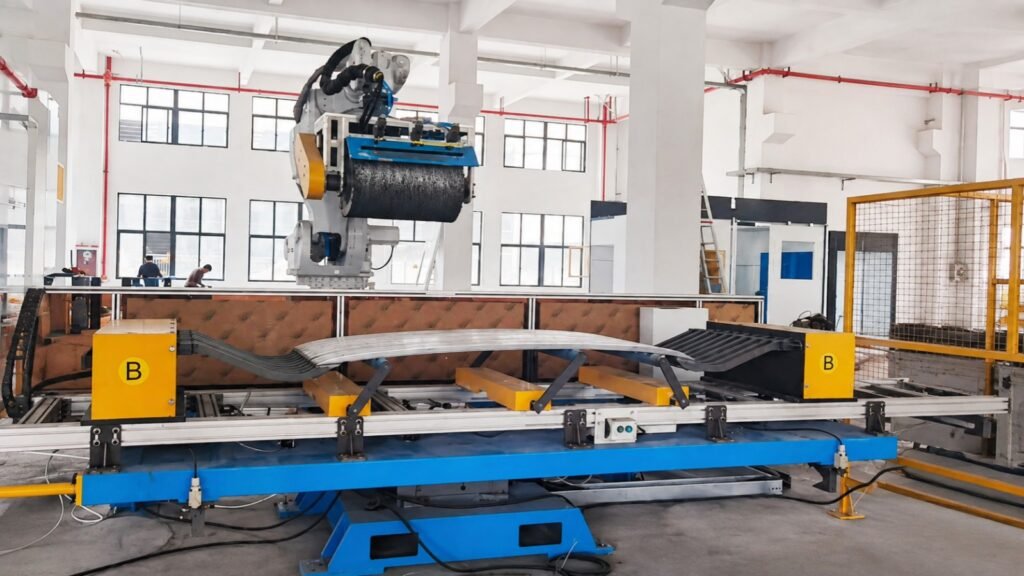
One of the first questions we hear from manufacturers considering polishing automation is simple:
“Can this part be polished by a robot?”
In many cases, the answer is yes. But whether a part can be polished automatically and whether it is a good candidate for robotic polishing are two different questions.
A successful polishing project depends on much more than installing a six-axis robot in front of a polishing wheel. Part geometry, material, casting variation, fixture design, abrasives, surface requirements and production volume all affect the final result.
Before deciding on a robotic grinding and polishing system, we normally start by looking at the actual part and its existing finishing process.
Here are eight practical points worth checking.
1. Start With the Required Surface, Not the Robot
The first question should not be which robot brand to use.
It should be:
What surface do you need after finishing?
Different products may require very different processes.
A die-cast automotive bracket may only need parting lines and sharp edges removed. A brass faucet may need several grinding and buffing steps before electroplating. A stainless steel decorative part may need a uniform satin finish, while another component may require a high-gloss surface.
These are completely different jobs.
Before designing the automation, it helps to define:
- Current surface condition
- Defects that need to be removed
- Required final appearance
- Whether dimensional control is important
- Whether the part will be plated, painted or coated afterward
- Which areas must not be polished
For parts requiring both material removal and final polishing, a single polishing wheel is often not enough. The process may require abrasive belts, flap wheels, sisal wheels and cloth wheels at different stages.
This is why we treat polishing automation as a process project rather than simply a robot project.
2. Check Whether the Robot and Tool Can Reach the Required Surfaces
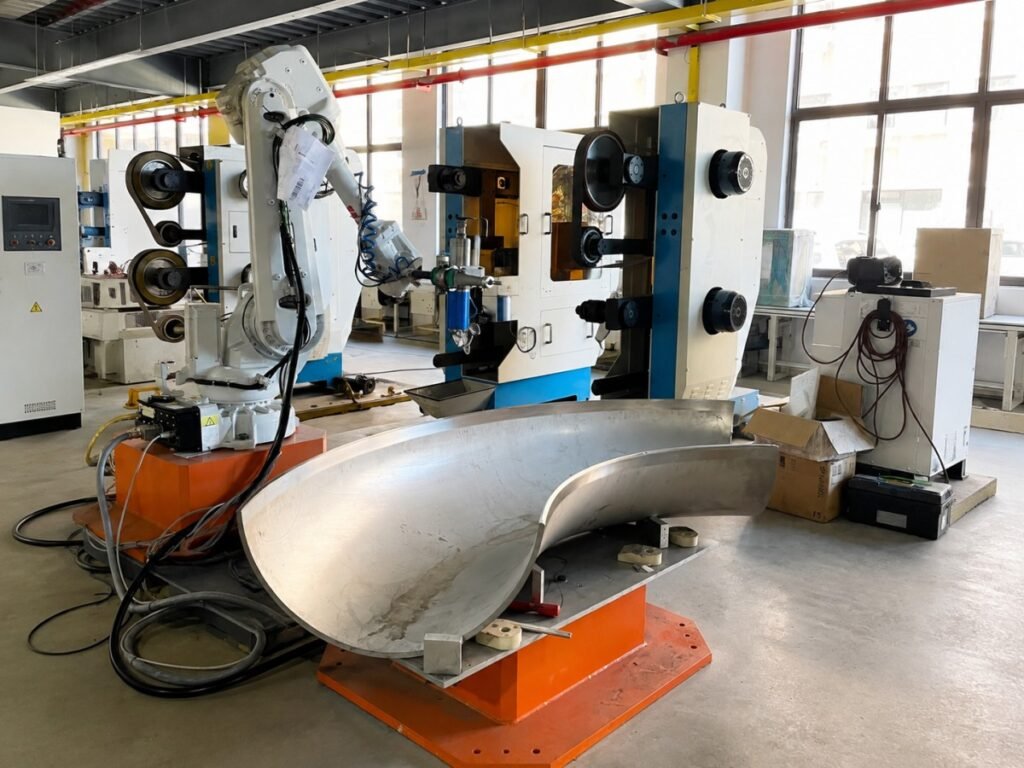
Part geometry is one of the most important factors.
Robots are particularly useful for components with curved surfaces, changing angles and multiple external faces because the robot can continuously change its position and orientation.
Typical examples include:
- Faucets and sanitary hardware
- Door handles and locks
- Aluminum and zinc die-cast housings
- Automotive trim and structural components
- Furniture hardware
- Metal brackets and frames
- Cast metal parts with irregular external surfaces
However, deep internal cavities, very narrow channels or areas blocked by the workpiece itself may be difficult for a standard polishing wheel to access.
In these situations, we look at the entire combination of robot movement, tool diameter, spindle position and fixture orientation.
Sometimes the solution is not a more complicated robot path. A better fixture or a different polishing tool can make the process much easier.
Our Technology page shows why fixture design, equipment layout and process planning are considered together during system development.
3. Material Changes the Polishing Process
“Metal part” is still a very broad description.
Aluminum, brass, stainless steel, carbon steel and zinc alloy behave differently when they are ground or polished.
For example, aluminum is relatively soft and can be sensitive to aggressive cutting conditions. Stainless steel normally requires careful control of heat and abrasive selection. Brass decorative parts often involve multiple stages before the required bright surface is achieved.
The original manufacturing process also matters.
A machined aluminum component has a different starting surface from an aluminum die casting. Likewise, a forged component, welded component and sand casting may all require different amounts of material removal.
For this reason, we normally need to know:
- Part material
- Casting, forging or machining process
- Existing surface defects
- Current manual finishing steps
- Abrasives currently being used
The abrasives already used successfully by experienced operators are often useful reference information when developing an automated process.
4. Part-to-Part Variation Can Be More Important Than Shape
A robot repeats programmed motion very accurately.
The workpieces do not always repeat that accurately.
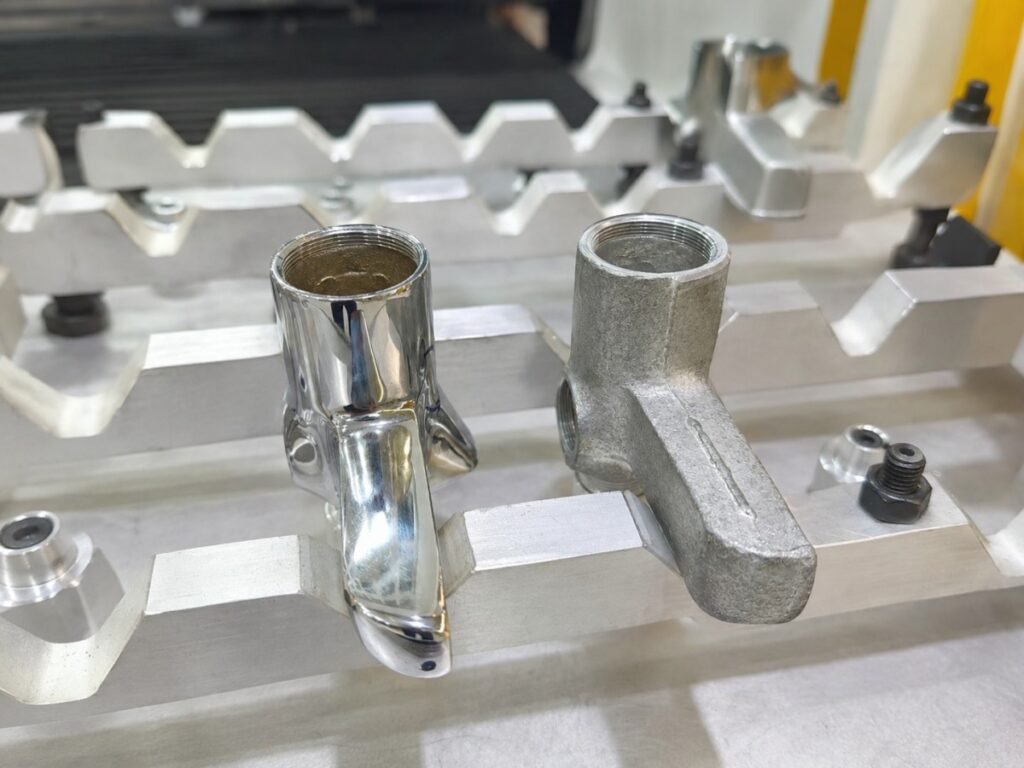
This difference is especially important with castings.
Two parts from the same mold may look almost identical, but parting lines, flash, surface height and local defects can still vary. Welded products may have similar variation around weld seams.
If the robot follows exactly the same rigid path on every part, these differences can lead to uneven material removal.
That is why curved and variable parts often require a combination of appropriate compliance, contact-force control and process allowance.
This is also one reason we prefer to evaluate several actual production samples rather than one specially selected sample.
If the parts are cast, it is useful to send samples from different production batches. This gives a much more realistic picture of what the automation system will face during normal production.
5. Production Volume Matters — But There Is No Single Minimum Quantity
Factories sometimes ask:
“How many pieces per day do we need before robotic polishing makes sense?”
There is no universal number.
A high-volume product is obviously easier to justify because the same program and fixture are used repeatedly. But lower-volume production can also be suitable when the polishing work is difficult, labor-intensive or requires consistent finishing.
What matters more is the overall production situation.
Consider:
- Number of parts per shift
- Number of working shifts
- Manual polishing time per part
- Number of operators currently required
- Frequency of product changeovers
- Number of different models
- Quality consistency requirements
- Difficulty of hiring or retaining experienced polishing workers
For factories producing several similar products, one robotic cell may also store multiple programs and use replaceable fixtures.
The important point is not simply whether production is “high volume.” It is whether enough of the finishing process can be standardized and repeated.
6. A Good Fixture Is Often as Important as the Robot
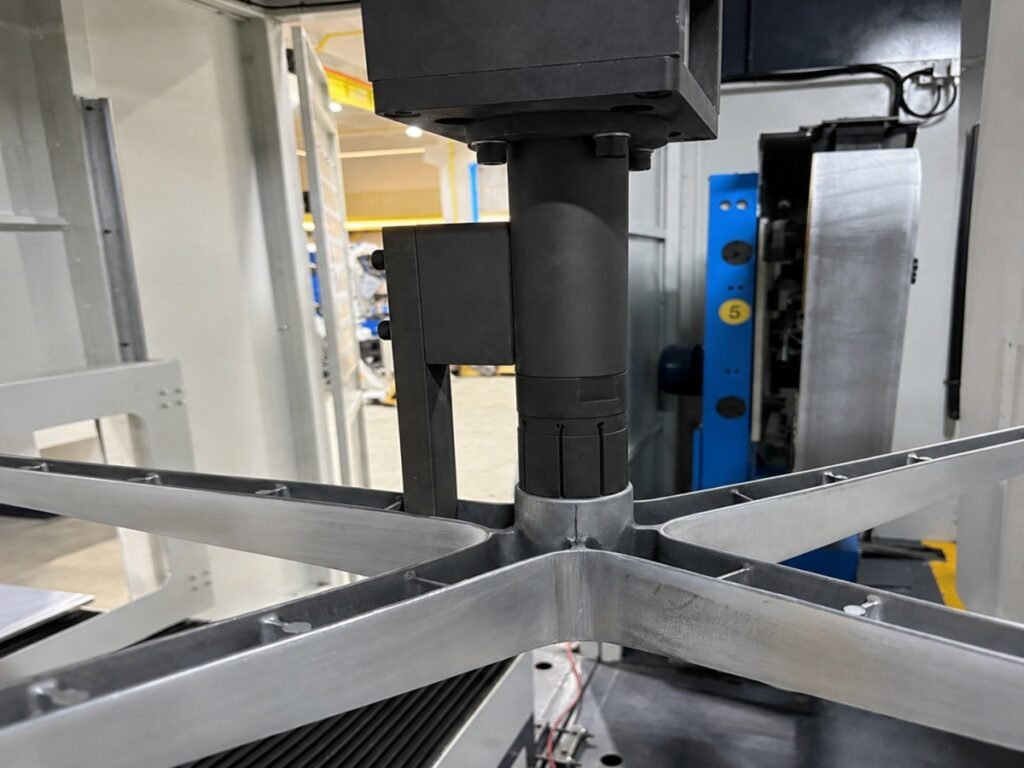
Fixtures do not attract much attention in demonstration videos, but they are critical in real production.
Every workpiece must return to a predictable position.
If the fixture allows the part to move, tilt or sit at a slightly different angle each time, the robot may contact the polishing wheel differently even though the robot program has not changed.
A good fixture should:
- Locate the workpiece repeatably
- Hold it securely during grinding or polishing
- Avoid blocking surfaces that need to be processed
- Allow practical loading and unloading
- Support fast changeover when multiple models are produced
- Withstand repeated production use
Fixture design becomes even more important when the workpiece itself has casting tolerance or an irregular shape.
For some projects, we use multi-part or multi-station fixtures so that loading, unloading and finishing can be organized around the required cycle time.
The fixture should therefore be designed as part of the polishing process, not added after the robot program is finished.
7. Think About the Entire Finishing Sequence
A common mistake is to show a supplier only the final polishing step.
In actual factories, a product may pass through several manual operations before it reaches the desired finish.
A typical sequence might look like:
Rough grinding → intermediate sanding → fine sanding → sisal buffing → cloth wheel buffing
Another product may only require edge deburring and one finishing step.
Before automating, write down what operators currently do.
Which abrasive do they use first?
Where do they apply more pressure?
Which areas take the longest?
When do they replace the abrasive?
Are there areas they intentionally avoid?
These details are useful because experienced polishing operators already understand many characteristics of the part. Automation should convert that practical process knowledge into a repeatable production method.
For example, our brass padlock robotic polishing case shows how polishing automation must be developed around the actual component rather than around a generic robot motion.
For sanitary hardware, the process may also be different again. You can see one example on our brass water tap polishing solution page.
8. Consider Loading, Dust Collection and Daily Operation
A polishing system does not operate in isolation.
Before automation, it is worth looking at what happens immediately before and after polishing.
Questions we normally consider include:
- How will operators load the part?
- How will the finished part be removed?
- Is automatic loading necessary?
- Where will abrasives be replaced?
- How much polishing dust is generated?
- Where can the extraction ducts be connected?
- Is sufficient floor space available?
- Does the operator need access for inspection?
- How often will product models change?
These details can affect the equipment layout as much as the polishing process itself.
Grinding and polishing generate dust and consumable wear, so enclosure design, maintenance access and dust extraction should be considered from the beginning rather than added as an afterthought.
This is particularly important when evaluating a complete automation system instead of buying only a robot arm. We discussed several related issues in our guide to the hidden risks of robotic grinding and polishing systems.
What Types of Parts Are Usually Good Candidates?
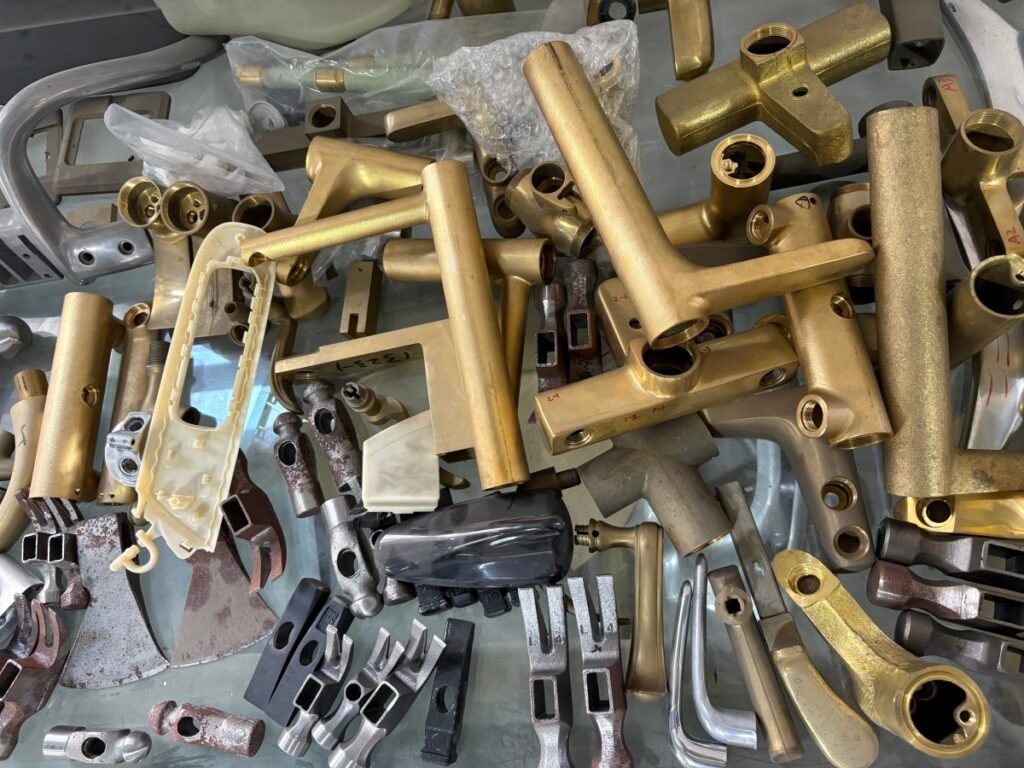
Although every project should be tested individually, there are several types of components we frequently evaluate for robotic surface finishing.
Aluminum and Zinc Die-Cast Parts
Typical requirements include removing parting lines, flash, casting marks and local surface defects.
These parts are common in automotive hardware, equipment housings and other industrial products.
For automotive applications, our Auto Parts Hardware section shows several examples of grinding, polishing and deburring processes used on different components.
Brass Faucets and Sanitary Hardware
Faucets, valves, handles and other decorative brass parts often involve complex curved surfaces and multiple finishing stages.
Surface consistency is particularly important when polishing is followed by plating.
More examples can be found in our Bathroom Hardware applications.
Door and Furniture Hardware
Handles, knobs, lock bodies and decorative fittings are often repetitive products with defined finishing areas, making them practical candidates for polishing automation when production volume and product consistency are suitable.
Stainless Steel Components
Stainless steel parts can be processed for grinding, satin finishing or polishing, depending on the required final surface.
The process needs to be matched carefully to the material, geometry and heat generated during finishing.
Irregular Cast Metal Components
Complex castings are one of the areas where six-axis robots can be especially useful.
Instead of requiring an operator to continuously rotate and reposition a heavy or awkward component, the workpiece and abrasive station can be arranged so that the robot controls the contact angle throughout the process.
Parts That Need More Careful Evaluation
Robotic polishing is flexible, but it is not automatically the best answer for every product.
Projects need more careful evaluation when:
- Every workpiece is significantly different
- Production consists mainly of one-off parts
- Surface defects appear randomly and vary greatly
- Important areas cannot be accessed by available tools
- The workpiece has no reliable locating reference
- Extremely thin sections can easily deform
- Manual polishing depends heavily on visual judgment that has not yet been standardized
This does not necessarily mean automation is impossible.
It usually means additional testing, sensing, tooling or process development may be necessary, and the economics need to be considered carefully.
A supplier should be willing to point out these limitations instead of simply saying that every part can be automated.
What Should You Send for a Robotic Polishing Feasibility Check?
You do not need to prepare a complicated technical document before discussing a project.
The following information is usually enough for an initial evaluation:
- Clear photos of the complete part
- Photos showing the areas that need grinding or polishing
- Part dimensions or a drawing
- Material
- Part weight
- Current polishing process
- Current abrasives and polishing compounds
- Required final surface
- Production quantity per day or shift
- Several actual samples if process testing is required
If possible, a short video of the existing manual polishing process is particularly useful.
It shows how the operator holds the part, which surfaces require the most work and how many polishing steps are currently being used.
Frequently Asked Questions
Can one robotic polishing machine process different products?
Yes, in many applications different programs and replaceable fixtures can be used for different parts.
How practical the changeover is depends on the differences in part size, geometry, material and polishing process. Products that share similar finishing requirements are usually easier to combine within one system.
Can rough castings be polished by robots?
Yes, many cast parts can be ground, deburred and polished robotically.
However, casting variation needs to be considered carefully. Samples from normal production should be tested rather than relying only on an ideal sample.
Does robotic polishing completely replace manual polishing?
Not in every factory.
Some production lines automate the complete process, while others first automate the most repetitive, dusty or physically demanding stages and retain manual work for inspection or occasional rework.
The appropriate level of automation depends on the product and production requirements.
Is force control necessary for robotic polishing?
It is particularly useful when the process involves contact with curved surfaces or when small part variations need to be accommodated.
The correct approach depends on the workpiece, abrasive process and required surface quality.
Should we send a drawing or a physical sample?
A drawing and clear photos are usually sufficient for an initial discussion.
Physical samples become much more important when the supplier needs to develop and verify the actual polishing process.
Final Thoughts
The question is not simply whether a robot can move around the part.
A good robotic polishing project needs the part, fixture, abrasive, contact condition, robot path and production workflow to work together.
Before investing in equipment, start with the actual parts being produced and the real problems in the current polishing process.
If you are evaluating robotic polishing for a metal component, send us part photos, drawings, material information and your current finishing requirements. Our engineering team can review the application and determine which areas can be automated, what process may be required and what type of system is suitable for production.